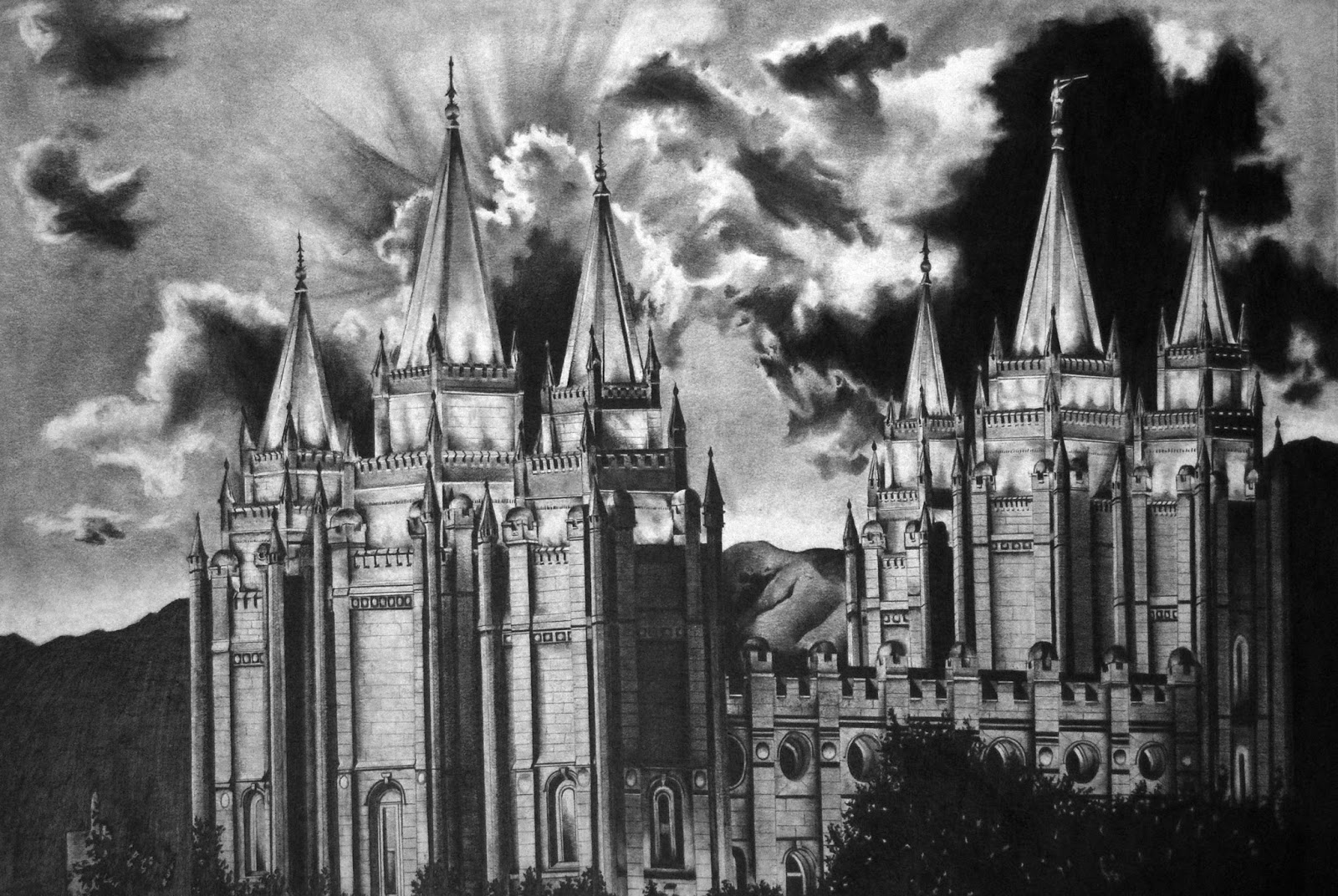
Showing posts with label Salt Lake Temple. Show all posts

Saturday, August 15, 2026

The Great Salt Lake Temple Photographic Robbery/Ransom Tale of 1911


                           The Deseret Evening News headline from September 16, 1911.


     THE iconic Salt Lake Temple was wildly in the news for photographs, not of its gothic looking exterior, but for surreptitiously obtained interior pictures, back in September of 1911, just over 18 years after the Temple was dedicated.

  What unfolded was a tale of lies, deceit and blackmail against The Church of Jesus Christ of Latter-day Saints.

  Here’s a summary of what took place:

  Gilbert L. Bossard, a German convert to the Church, was living in Salt Lake City. He excelled at photography. In an interview, Bossard said that he spent the better part of an entire year sneaking into the Salt Lake Temple with a camera and taking a total of 68 inside photographs.

  He said he often hid a camera under his coat. He may have also convinced an assistant gardener on the Temple grounds (according to the Salt Lake Telegram newspaper of Sept. 18, 1911) to help him gain access to the interior of the Salt Lake Temple, at times. There is even a tale that he may have entered into the Temple’s interior through a large heating vent.

  In any event, he had the photographs to prove that he somehow took them, even though in one interview, he said it was usually that he was only able to take one interior photo with each visit to the Temple.

  Other than the 600 VIPs who got to tour the inside of the Salt Lake Temple, before it was dedicated, in 1893, there were no other public tours of its interior, Hence, there was a lot of curiosity about inside, where only members with a Temple Recommend could go.

   Bossard took his photographs and sold them to Max Florence, a motion picture businessman, who was formerly of Salt Lake City and since moved to New York City.

  It was no secret that Florence was in financial trouble.

  “Max Florence on financial rocks?” was a November 11, 1910 headline in the Deseret News, outlining his financial debts.

  So, he wanted to blackmail the Church into giving him money to not release the pictures publicly. In one interview, he mentioned a $100,000 sum of ransom, but then said that was not the amount.

  “Max Florence fails to scare the Church” was a September 16, 1911 headline in the Deseret Evening News.

                             President Joseph F. Smith                            From Wikipedia Commons.

  Church President Joseph F. Smith said, “I will make no bargain with thieves or traffickers in stolen goods. I prefer to let the law deal with them.”

  President Smith also stressed that the inside of the Temple was sacred, not secret.

                                  The Deseret Evening News from September 18, 1911.

    (Note that until the later 20th Century, public tours of undedicated temples were rarely given and so to outsiders, the Latter-day Saints’ Temples were somewhat “mysterious.”)

  Florence seemed to also want to discredit the Church and even boasted that he could steal the Angel Moroni statue, if the Church made him any madder. He also said he knows the Salt Lake Temple as well as its architect (Florence was not a member of the Church and he also seem to brag as if he took the pictures, when they were taken by Bossard).


                             Elder James E. Talmage.                                From Wikipedia Commons.

  Elder James E. Talmage made a suggestion to the First Presidency in September of 1911, that he could write and compile a new book, “The House of the Lord,” that could include high-quality interior photographs of the Salt Lake Temple, taken by their own photographer, thus stealing Florence’s thunder, as well as handling the pictures in a complimentary and explanatory way, instead of for revenge and ransom.

   It was a bold, but clever move. That book was published a year later and contained 31 interior temple pictures. (Elder Talmage was made an Apostle in December of 1911.)

 Note that back in 1911, there was no quick way to release photographs to the public, as there is today, so a printed book was considered the optimal and widespread method.

   The Salt Lake Tribune reported on October 4, 1911, that Bossard, who took the unauthorized interior Salt Lake Temple photographs, was excommunicated. Years later, living on the East Coast, Bossard tried to regain his Church membership, but Church leaders said he failed to recognize how badly he had discredited the Church and its flagship temple.

  -Perhaps a long-lasting after effect to this incident was a phobia, a fear, among Church leaders, that the Holy Edifice could be invaded again. Security at the temple was probably reviewed and improved after the incident, And, as such, the Salt Lake Temple also had an iron fence around it and only members with recommends could get close to the Temple, or touch it. (No other temple seemed to have a similar barrier.) That didn’t change until about 2001, when the Church prepared to welcome the world for the 2002 Winter Olympics in Salt Lake City. Then, the wall came down and there was more open access to the Temple Square grounds around the Salt Lake Temple itself.

  -In addition, to this writer’s advantage, when he prepared to write/compile a new book, “Images of America Salt Lake Temple,” he was surprised at how many great interior photographs of the Salt Lake Temple from the early 20th Century were available. Even though he knew of the “stolen photographs” story, it was a long time before he connected the dots and realized that without that ransom incident, such a book would likely not be possible, because of not nearly enough official inside pictures of the Salt Lake Temple being otherwise available, to support such a vintage picture book. (This new book will be available in April of 2027, through Arcadia Publishing.)

-If you would like a more detailed (and scholarly) examination of the Salt Lake Temple stolen photographs incident, “I’m Here for the Cash”: Max Florence and the Great Mormon Temple,” By Gary James Bergera, was published in the Utah Historical Quarterly, Volume 47, Number 1, 1979.

A link, to cut and paste, to that lengthy article:

https://issuu.com/utah10/docs/uhq_volume47_1979_number1/56?e=65&o=1


Sunday, May 13, 2018

Is the foundation of the Salt Lake Temple composed of granite or sandstone?


DOES the famous and historic Salt Lake Temple actually sit on a base of all granite?
There’s no doubt that a sandstone base, taken from Red Butte Canyon, was the Temple’s original base. But is any of the sandstone still there?
The vast majority of all Internet searches find sources that imply the sandstone base was entirely removed – it is all granite now.
The most authoritative of these sources is from the BYU Religious Studies Center at:
This report states that the Temple’s foundation was covered as the U.S. Army approached Salt Lake in the summer of 1857.
Then, as the Army threat disappeared, the foundation was uncovered as Temple work was ready to resume.
The BYU Religious Studies history of the Salt Lake Temple then states:
“At this time, President Young examined the newly uncovered foundation and became aware that it was defective. He and his associates noticed large cracks and concluded that its small stones held together with mortar could not carry the massive weight of the temple. On January 1, 1862, he announced that the inadequate foundation would be removed and replaced by one made entirely of granite. The footings would be sixteen feet thick. “I want to see the Temple built in a manner that it will endure through the Millennium,” he later declared. The work of rebuilding the foundation moved slowly, and the walls did not reach ground level until the end of the construction season in 1867, fourteen years after the original cornerstones had been laid.”


However, this report can be supplemented by several Deseret News stories, including a photograph from the early 1960s.
The Deseret News of March 30, 1963 published a photograph of when extensive excavations were made around the base of the Salt Lake Temple. This photograph lists the granite foundation as 14 feet deep (two feet less than the BYU article stated).
It also clearly shows a sandstone sub-foundation still there, underneath the granite foundation.
So, technically both statements of a granite or sandstone base are true.
An earlier Deseret News story on Sept. 8, 1962, stated:
“The story of the foundation and the back-breaking labors of the pioneers who toiled with oxen to haul giant pieces of granite from Cottonwood Canyon quarries to replace an original foundation of sandstone has been told.”
Thus, if there ever was a full foundation of sandstone up to the ground level, then the upper 14 feet of that base had to have been removed and replaced with granite. However, the BYU story stated that the temple structure didn’t rise to ground level until 1867, or 10 years after the threat from the U.S. Army. So, this casts some doubt on a full underground base of sandstone ever existing.
Notwithstanding, it is a fact that some 14 feet to 16 feet of lower sandstone sub-base still remain below ground.
The 1963 Deseret News story stated that the sandstone sub-foundation was 30 feet down. Amazingly, only hand tools, horse and oxen power created that foundation.
This sandstone sub-foundation covers an area of 4,850 square feet.
The photograph also reveals how layered in blocks and even partially eroded the sandstone sub-foundation appears to have been in 1963.
During the 1963 renovation, cement wells and footings were added to replace the previous rocky subsoil. At the same time of the 1963 underground improvements, underground passages were also added.
-“Facts about the Temple” was an Oct. 22, 1891 story on the S.L. Temple in the Salt Lake Herald newspaper. This article accurately mentions the deepest foundations as being sandstone.
“The Salt Lake Temple foundation is not laid of granite from Cottonwood canon (sic), as has been stated, but is of the same kind of sandstone as the temple block wall foundation – we call it firestone – and has never been disturbed or taken up and relayed as has been stated …” the Herald story stated.
The Herald also explained that oxen hauled the sandstone from a spur in the mountain a little south of the mouth of Red Butte Canon (sic), in blocks about three feet thick.
Back to the Deseret News’ 1963 photograph, it does appear to show the three-foot thick sandstone blocks in the sub-foundation.


-One other interesting excerpt from the BYU Religious Studies article on the history of the S.L. Temple is this:
“Because the builders recalled President Young’s desire for this temple to stand through time, the structure was very solid. Even at their tops, the walls were six feet thick, and the granite blocks were individually and skillfully shaped to fit snugly together. Nearly a century later, Elder Mark E. Petersen attested to the soundness of the temple’s construction. He was in the temple when a rather severe earthquake hit, damaging several buildings around the Salt Lake Valley. “As I sat there in that temple I could feel the sway of the quake and that the whole building groaned.” Afterward, he recalled, the engineers “could not find one semblance of damage” anywhere in the temple.”
So, the finished Salt Lake Temple may be more earthquake resistant than some may believe – notwithstanding that sandstone sub-foundation.
-Still one more interesting fact from the BYU Religious Studies article is this:
“Some have suggested that in the Salt Lake Temple, shafts were provided for elevators and spaces left throughout the building for electric conduits and heating ducts even before these technologies were known. Angell Sr., (the temple’s architect) however, certainly would have learned about elevators, which were just coming into use at the time of his 1856 visit to Europe. By the early 1860s, electricity was already being used in Utah for the Deseret Telegraph system. Hence, most of the temple’s interior was designed and built long after these technologies emerged. Although the west center tower proved to be a convenient location for the two main elevators, there is no evidence to suggest that their shafts were planned when there was no knowledge of this technology.”


NOTE 1: The term "granite" is a layman's term in this article. Geologists probably have their own different scientific terms.

NOTE 2: It was announced in April of 2019 that the Salt Lake Temple will close at the end of 2019 for approximately 4 years for extensive remodeling. This will be the first remodeling of that temple since 1963, when some of the photos on this blog were taken. Extensive seismic upgrades will be made -- and the sandstone sub-foundation will surely be exposed again.


-Originally published in the Deseret News.

NOTE 2: Temples can be vulnerable to earthquakes. Example: The Logan Temple's main structural beam was found to be cracked in two when extensive remodeling work began in 1976. It was surmised that a past earthquake (possibly from the March 27, 1975 Pocatello Valley Idaho quake that was near the Utah-Idaho border and equaled 6.3 in strength), damaged it.
Thus, if the temple had simply been renovated, the roof could have eventually collapsed. Fortunately, a total rebuilding inside the walls and roof was done.

Friday, May 19, 2017

Salt Lake Temple: Most Expensive LDS Temple Ever?


By Lynn Arave

THE next time you enjoy the gothic and symbolic features of the one and only Salt Lake LDS Temple, consider it’s dollar price to build -- $3,469,118.
That was the price given by Elder George Reynolds, a member of the Quorum of the Seventy, back in 1895, to a Philadelphia newspaper, as quoted in the Deseret Weekly News of March 23, 1895.


Factor in the inflation and even in 1916 dollars (the furthest back an on-line government inflation calculator goes), that price equals at least $86,559,450 in 2017 dollars.
(The Church of Jesus Christ of Latter-day Saints hasn’t revealed the actual costs of any temples for many decades now.)
However, in contrast the San Diego Temple, which opened in 1993, was reported by the Los Angeles Times to have cost an estimated $24 million. (That’s $40.6 million in 2017 dollars.)

                                                             San Diego Temple.

And, the original Ogden Temple, that opened in 1972, cost $4.29 million (or some $25 million in today’s dollars.)
Note that the Salt Lake Temple required some 40 years to build – far more than any other temple. Also, some volunteer, unpaid labor was used back then, or the price over four decades likely would have been much more, likely $100 millon plus.
Furthermore, Elder Reynolds in that 1895 article stated that exact costs of the temple were impossible. Still, he said about the Salt Lake Temple’s construction:


“In the early stages the progress was slow and very expensive, for it took four yoke of oxen four days to bring a single stone from the quarry twenty miles distant.”
He said some estimated it cost $100 for every stone cut, moved by oxen to the temple site and then laid in place. He also stressed that metal and other materials were very expensive to obtain, especially until the railroad came long.

                                                        Pencil drawing by Steve Arave

Saturday, August 9, 2014

When Snow fell in August and a Salt Lake Temple invasion


By Lynn Arave

SNOW in August is probably the least likely time for a taste of winter in the Top of Utah. However, “Snowstorm in middle of August” was an Aug. 19, 1912 headline in the Ogden Standard-Examiner.
Travelers going from Woodruff, Rich County, over the mountains into Huntsville on Aug. 18 that year, encountered a “heavy snowstorm.”
Temperatures were reported near freezing at Huntsville and even “Observatory Peak” (Mount Ogden) received snow from the same storm that day.


More history:
-Reports of a “mysterious invasion” of the Salt Lake Temple comprises another strange news item, also from just over a century ago.
“Invades the Mormon Temple” was the headline. According to the Standard of Sept. 16, 1911, a blackmailer was trying to extort $100,000 from The Church of Jesus Christ of Latter-day Saints. The criminal supposedly had “flashlight photographs” of the interior of the Mormon Temple and would publish them, if not paid off.
Max Florence, the former “movie king” of Salt Lake City was believed to be the alleged blackmailer and now residing in New York City.


LDS Church President Joseph F. Smith was quoted as saying, “That the Church authorities did not desire to enter into any negotiations with thieves and blackmailers.”
He also said he didn’t care if the photographs were published or not, since some 800 non-members of the Church had toured the inside of the temple before its 1893 dedication.
President Smith said furthermore that the pictures were not taken by flashlight, but likely a few months earlier when the temple was closed for cleaning. That’s because some furniture in the photos were covered by canvas.
It was later determined that an accomplice, an active Elder in the Church, who also had special access to the Temple, had taken the photographs for Florence. He was later excommunicated from the LDS Church for his actions.
Florence meanwhile, was known to be in personal financial trouble. However, he first scoffed at the alleged $100,000 ransom for the pictures, claiming if had actually done that, he would have asked for a lot more money. By January of 1912, Florence had returned to Salt Lake and said he had received some offers to buy the temple pictures, but had taken none, because the buyers wanted him to defame the LDS Church and he would not do that.
That controversy then faded away. (However, Florence was arrested twice in succeeding years for separate issues. In 1917, he was arrested on a felony for false imprisonment of a theater owner. In 1918, he pleaded guilty to breaking Utah’s “dry law,” by bringing in barrels of whiskey from Wyoming.)
 -More history: “Muzzle the bulldogs” was a May 19, 1911 editorial in the Standard. Pitbulls may be the most controversial canine breed today, but bulldogs in that era were the hot issue.
The editorial cited the death of a dog and a cat as recently happening in Ogden from bulldog attacks, plus a Salt Lake girl, 10, was attacked and injured by a loose bulldog in that city.
(-Originally published in the Ogden Standard-Examiner on August 8, 2014.)


-NOTE: The author, Lynn Arave, is available to speak to groups, clubs, classes or other organizations about Utah history at no charge. He can be contacted by email at: lynnarave@comcast.net