Monday, October 3, 2016

‘The Oaks,’ An Ogden Canyon eatery beginning in 1903 -- Before the Hermitage


By Lynn Arave

THE Oaks is a delightful little restaurant in Ogden Canyon and is the oldest operating business in the Canyon -- even predating the Hermitage.
The Oaks is often stated as having begun in 1907, but it is actually even older.
"The Oak's Summer Resort, A pleasant retreat in Ogden Canyon discovered by City officials today" was a June 10, 1903 headline in the Ogden Standard Examiner.
A group of Ogden leaders on a retreat found themselves "seated beneath the shady trees at 'The Oaks,' as beautiful, clean and neat a spot as can be found anywhere in the canyon, conducted by Potter Bros. of Ogden, Ginger ale, lemonade and soda water, with an occasional stick in it, can be procured here at the usual prices," according to the Standard story.
The City leaders also noticed how well the grounds were kept at The Oaks, at a feast there "on short notice" and also discovered "At this resort, no one under the influence of liquor can be served."


                                      The Oaks in the 1910s.
              -Photo from the Utah Division of State History

In the July 31, 1903 Standard-Examiner was a report of some Ogden sisters who picnicked at The Oaks.
On Aug. 6, 1903, the first outing of the Ogden Automobile Club was a drive to The Oaks and a banquet there, according to the Standard-Examiner. There were tables and meals served in 1903 at The Oaks.
The Standard-Examiner of Sept. 5, 1905 stated that a boxer, Mike Schreck, was getting in shape for a big fight and was training at The Oaks.
The Standard of Sept. 12, 1905 reported that it was the Canyon Resort Company that operated The Oaks and the business was making plans for a new restaurant and cottages. Plans also included a new system of roads through the place and a trail up the mountainside.  

                        The Oaks today, very shady and casual.

"Big time at The Oaks. Celebration at Ogden Canyon a huge success. Great crowd gathered at the popular resort and they had the time of their lives" (at “Valley Day”) was an Aug. 20, 1907 Standard headline. (So, it may be that The Oaks simply hit its stride in popularity in 1907 …)
 "Valley Day" was some sort of Ogden Valley celebration and that was what was being celebrated at The Oaks. Residents from Eden, Liberty and Huntsville attended.
(The Standard of Aug. 5, 1904 had also reported "Valley Day" being celebrate at The Oaks that year too.) 
"Lightning hits The Oaks Resort" was a Sept. 1, 1909 headline in the Standard-Examiner. A resort guest, Miss Bertha Parkinson, was struck by lightning at about 5 p.m. on Aug. 31 as a storm rolled by. The efforts of a Dr. Woolley and others are credited in saving her, as she was believed to have taken the full force of the bolt and was seemingly dead for a time.
The June 26, 1910 Standard-Examiner stated that The Oaks had improved its camping grounds, erected some new cottages and was still famous for the chicken and trout dinners served in its cafe.
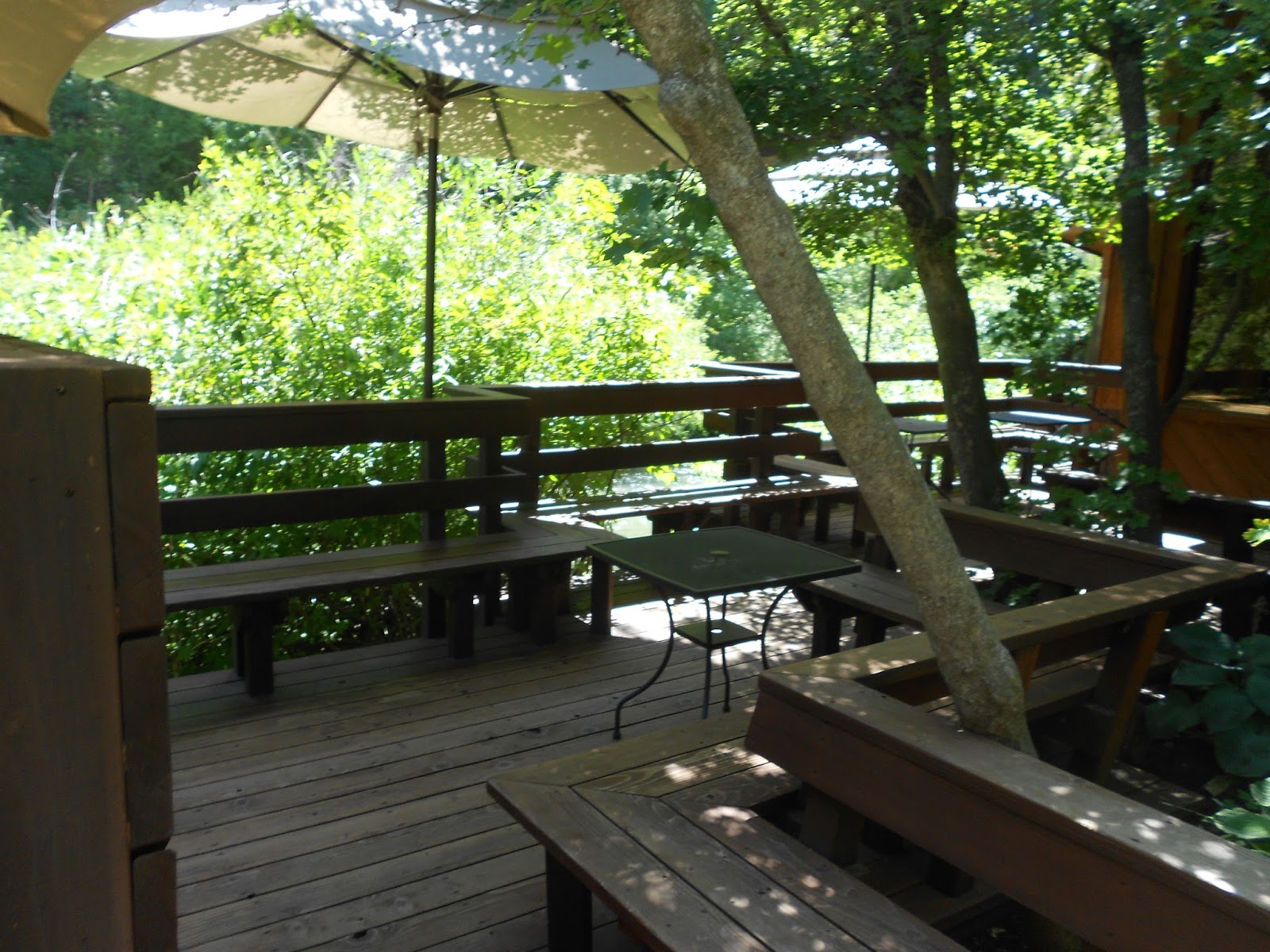

                          The outside waiting area at the modern Oaks.


The Oak's own history states that the original Oaks was about a mile from its current location and built by C.S. Potter. It doesn't say if that was east or west, though. It was in 1933 that The Oaks moved to its current location -- higher ground -- to avoid frequent flooding from the Ogden River.
The Oaks was purchased in 1981 by Keith and Belinda Rounkles. They renovated the place into a full service eatery, serving breakfast, lunch and dinner.

                    A view right from an eating table to the Ogden River.

In 1994, the Rounkles purchased 160 surrounding acres to ensure that the surrounding area remains more natural.
Nestled in some oak and other trees along side of the Ogden River, this restaurant has some indoor seating, but an outdoor table next to the Ogden River in the summer season may require a wait.

The Oaks has reopened in November of 2025 under new ownership, after 4 years of closure, since 2021.

-The Oaks, 750 Ogden Canyon, was located four miles, or about 7 minutes up the Canyon. Take 12


                               A rugged peak in Ogden Canyon to the north of the Oaks.


Legends of the 2 Taylor Canyon gold mines


       Taylor Canyon holds at least two gold mines and has an extensive mining legacy.

By Lynn Arave 

LEGENDS of gold mines are some of the most intriguing tales in the American West and Ogden has its own such storied fables and perhaps the two (yes, at least 2) lost gold mines in Taylor Canyon top the list.


   Taylor Canyon contains old waterlines, as well as lost and abandoned mines.

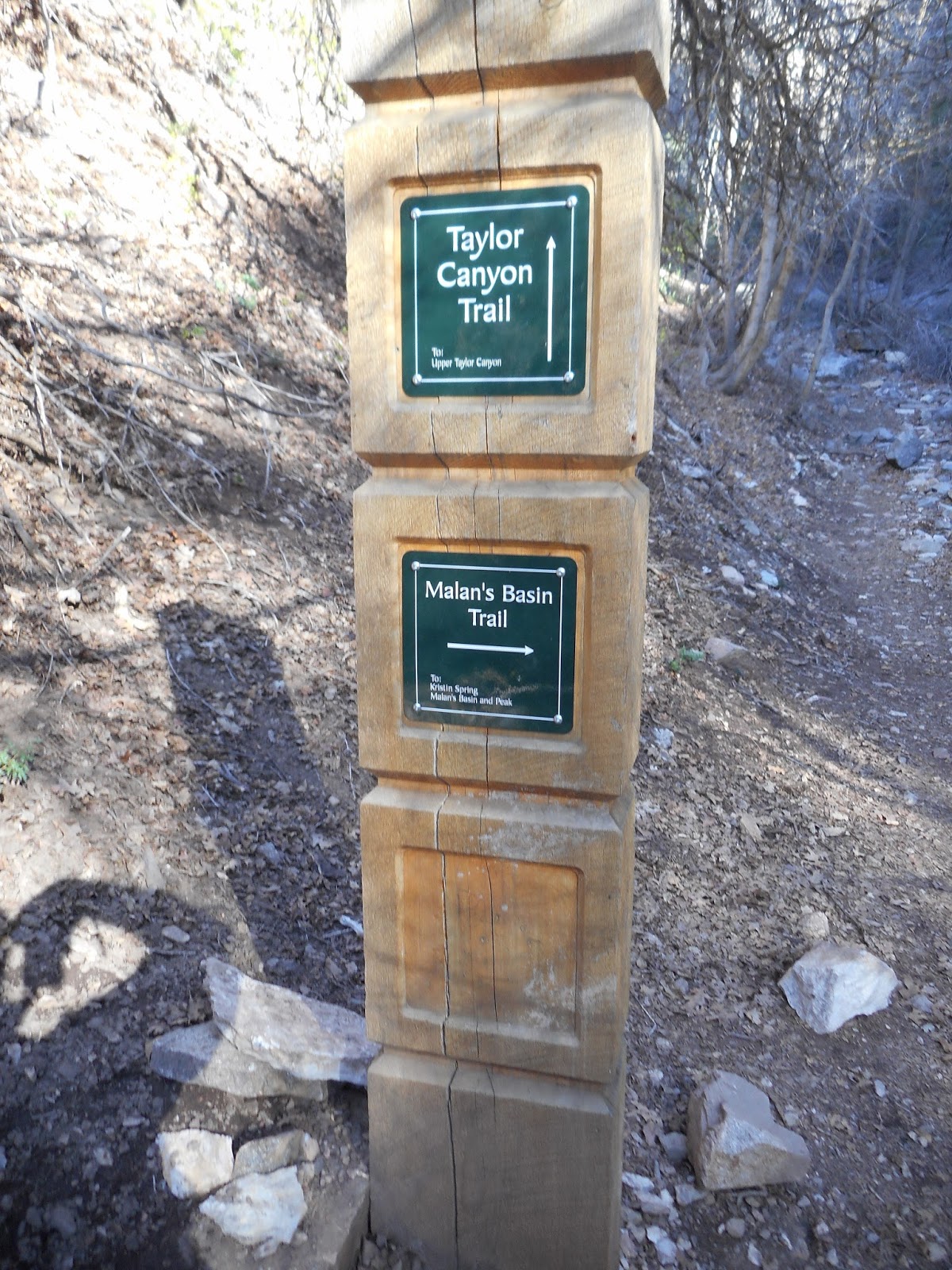
Taylor Canyon, located east of Ogden’s 27thStreet and a popular hiking gateway to Malan’s Peak and Malan’s Basin, may actually contain some lost gold mines.

  This old cabin, shown in the late 1970s, is one of the many mysteries of Taylor Canyon.


According to the Ogden Standard-Examiner of June 26, 1913, “Gold exposed by bolt of lightning” happened in Taylor Canyon. The story states that an unnamed prospector was traversing through the canyon on June 23 that year when a bolt of lightning “shattered the cliff and revealed the rich metal, but in haste to get out of the storm the miner gained insufficient identification marks.”
He reportedly was still hunting for the spot, but with no further updates over the years, he apparently never found the treasured spot again.

-The Salt Lake Tribune of Oct. 18 1959 had a story titled,
"Ogden's Lost Mine Taylor Canyon holds the secret of a mine abandoned nearly 50 years." 
This story talks of a different gold mine in the canyon, abandoned in 1911, that a man with the last name of McDonald had created. He also built a nearby cabin, that the story reported had been found a few years later by a group of boys. They also said they saw a nearby shaft that went 25 feet or so into the mountain.
However that structure was destroyed by vandals in 1917 and Union Pacific, who later owned and managed Taylor Canyon for its timber, apparently collapsed the mine for safety reasons.
Many years later, McDonald returned with his two sons, but they were unable to find the mine again.
Was the mine really a gold mine?
The Tribune story stated:
“…When a miner is just prospecting, he usually pitches a tent or makes a lean-to for his shelter. This is all he needs, for he is just hunting ore—he'll be moving on soon, if he doesn't have any luck. But when a miner discovers good ore and plenty of it and he plans on staying on the spot, then, and not until then, does he build a cabin—especially as fine a cabin as Mac's cabin was.”
(Now there was a separate, more modern cabin also located in Taylor Canyon in between the trail switchbacks on the south slope. That cabin’s origin is its own, separate mystery.)
Taylor Canyon has an extensive mining legacy. The Standard-Examiner of Oct. 6, 1899 reported a working gold and silver mine in the canyon called the “Last Chance Tunnel.” J.H. Haines was the miner of this claim, which ran 175 feet into the north side of Taylor Canyon.
The Standard of Aug. 31, 1904 states that there were 10 known mining claims in Taylor Canyon. The titles of some of these mines included” “Excelsior,” “”Curb Stone,” “Ogden Salmon,” “Psyche,” “Merrymack” and “Maybeso.”
So many mines in Taylor Canyon had names and were publicly known. A big “why” is how come no claim was filed for McDonald’s gold mine?
There may be lost mines in Taylor Canyon, but none gained widespread fame like the La Platta silver mine northeast of Ogden. Why? Perhaps because they weren’t very profitable.
Also, of note is that there are also stories and legends of other mines in the Ogden area, particularly those around Willard Peak and Ben Lomond Peak.

This very square rock, about one-half mile up Taylor Canyon, is both eye-catching and mysterious.


Wednesday, August 31, 2016

Lagoon’s original location: 3 miles southwest


           Lake Park, Lagoon forerunner in 1888.                              -From Utah State Historical Society.

By Lynn Arave

Lake Park,” forerunner to Lagoon, began on the shores of the Great Salt Lake.
This “Lagoon” was about 3 miles southwest of today’s theme Park and west of the western end of today’s Clark Lane. It was promoted as one of the “most attractive watering places in the west.”  It encompassed 215-acres and existed for about nine years there.
Utahns in the late 1800s loved their Great Salt Lake, where they could float like a cork and the original Lagoon capitalized on that popularity.
Railroad magnate Simon Bamberger, later Utah’s first ever Democratic governor in 1917, started Lake Park in 1886 to attract large crowds from Salt Lake County and to increase traffic on his railroad line.
Bamberger, more well known by Utah residents for the “Bamberger” railroad than as the father of Lagoon, built an approximate two-mile spur line off the main D & R.G.W. line to reach Lake Park Resort.
 Approxinately 53,000 guests visited the park in 1886.  Admission in those days was 50 cents. Swimming, dancing, boating, a merry-go-round pulled by a horse, target shooting, roller skating and bowling were all included for that price. An extra half-dollar provided a full course meal at the resort’s restaurant.
  For its premiere season, the resort had 15 dozen men’s and three dozen women’s swimming suits available for rent. To help prevent theft, “Lake Park Resort” was written across the front of the suits.
There were six trains a day, painted in a Tuscan red, going to Lake Park from Salt Lake City and three a day coming from Ogden. A sailboating racing and a rowing club also had headquarters at Lake Park.
   It also boasted of its open air dancing pavilion with finely carved archways and lattice.
  Summer cottages at the site were rented by the day or month. By one account, it even had a small Victorian style hotel and a string of cabins along the beach.
   The main pavilion was 3,600-square feet, flanked on the north by a restaurant, 30 X 60 feet in size and on the south by an equal sized saloon. On the west was a pier, about 150 feet in length.  Bath houses were north and south of the pier. The railroad passenger platform was on the east side of the large pavilion. There were also a dozen round picnic houses, covered with green ivy, and having tables underneath them.
Many Farmington residents would simply walk to Lake Park for a daily outing. Boat races and footraces were also popular events at Lake Park.
However, by 1895, the resort was suffering. The Great Salt Lake was still receding and now approaching its average level of 4,200 feet above sea level.
  What was once the lake shore was now a sticky, blue-colored mud that shunned swimmers.  It would have required a walk through muddy and smelly salt flats of some one-third mile or more to reach the actual lake water. Then, it would have been another long
walk to reach water deep enough to swim.
  Bamberger decided to move the resort eastward. He purchased what was then some 40 acres of swampy farmland, where noisy bullfrogs roamed, from Farmington farmers for his new location in the mid 1890s. (Some reports refer to the Lagoon site as natural meadows). Bamberger had the land graded and the swamp excavated to make a four-foot-deep lake.

                                The iconic wooden roller coaster arrived in 1921.

  Some accounts state it was actually two large ponds. In any event, the two lakes eventually became one large lake and also one that was larger than the one in use today - maybe almost twice as big. The frogs were sold as delicacies to Montana mining camps.
The original Lagoon location thrived as a salt works extraction area for almost 30 years until similar enterprises in Northern Utah put it out of business. The railroad tracks to the area were removed in 1925, due to a lack of usage.

                      A portion of the area where Lake Park was.

-Visiting Lagoon’s original location today (spring of 2016) reveals no obvious signs that a resort and railroad line were ever in the area. And, the Great Salt Lake –with its almost record low levels – is presently nowhere to be seen in the area either.

                  Birds love the old Lake Park area today.                                  Photo by Taylor Arave.


A horse ranch, pastures and wetlands dominate the former Lake Park Resort area, some 121 years after it moved.

A receding Great Salt Lake has left the old Lake Park area high and dry.


(-Originally published on Aug. 29, 2016 in the Ogden Standard-Examiner by Lynn Arave, in the Wasatch View section.)

Monday, July 25, 2016

Ogden's Lorin Farr Park before rodeo fame: World-class bicycling, different park name


 Charles A. Maccarthy, left, and an another cyclist races around the Ogden "Saucer"
 track in Glenwood Park (now Lorin Farr Park), circa about 1910.                                                            (Photo from Utah State Historical Society.)


By Lynn Arave

MENTION Lorin Fark Park today and it probably conjures up images of Ogden’s famous Pioneer Days Rodeo. However, the Park had a storied history long before rodeo fever took hold in Ogden and much of it was under a different name.
A park was first developed on the site, 769 Canyon Road, in about 1880. However, it was originally called Glenwood Park for more than three decades.
The park was a focal point for Ogden’s Fourth of July and Pioneer Day celebrations. Some of Ogden’s first fireworks displays were staged there.
Football, soccer and baseball games -- even track meets were held in the park during its early decades.
The adjacent Jones’s Grove, by the Ogden River, was considered the most refreshing summer swimming hole in the early 20th Century and even out of town tourists went there to cool off. In late winter, ice harvesting dominated this shady area by the Ogden River.


Long before rodeo came along in the park, there were world-class bicycle races there.
The “Saucer,” an indoor bicycle racing arena (velodrome) was built at the park in 1900. But in 1905, the race track did not make enough money to pay its bills and was struggling.
Still, the Los Angeles Herald had this headline on July 18, 1907:
“CYCLISTS BREAK RECORDS ON OGDEN SAUCER TRACK.”
The story stated: “Time for the Professional Mile Is Reduced to 1:48.1; Amateur Also Sets New Mark for Competitors -- At the Glenwood bicycle saucer track here tonight two world's records were lowered.”
By the 1910s, the rise of the automobile, the sport of golfing and then World War I equaled a drastic demise in the popularity of bicycle racing. Soon, the bicycle arena closed and was torn down.
A group of Ogden businessmen, led by William Glasmann, leased the park in 1911 with the hopes of developing a resort superior to anything Salt Lake City had. That effort didn’t fully succeed, but by 1918 there was a merry-go-round in the park and a children’s playground.
It was recommended in July of 1912 by the Daughters of the Pioneers for a new park name, to honor one of Ogden’s most prominent pioneers. After much debate, some favored the present title and others a neutral “Pioneer Park” moniker, but the Farr name soon won out.

                                             Lorin Farr

Lorin Farr (1820-1909) was a Mormon Pioneer, the first mayor of Ogden and the first president of the Weber LDS Stake. He also used to own the land where the park is and directed the building of a pioneer fort in the area in 1850.
By the 1920s, winter ice skating was a popular pastime at Lorin Farr Park and Ogden City had full control of the park again.  In the summer of 1922, a curfew was put in place and more lights added in the park to help prevent vandalism and teens making out.  Vandals damaged many park trees with hatchets.
In the spring of 1923, the park was spruced up and auto parking was expanded. Throughout the 1920s, a dance hall and “Penny Dances,” with 10-piece orchestra were a summer favorite there.
On July 4, 1923, the park was the center of Fourth of July festivities, with picnicking, games, pony rides and 60-foot tall Ferris wheel.
“Wild West Shows,” a forerunner to today’s rodeos, were popular in early 1900s Ogden and across the nation.
However, “Ogden Rodeo is called off” was an August 4, 1920 headline in the Ogden Standard-Examiner. A lack of proper facilities doomed that rodeo.  The first rodeo was held a year later in September of 1921 at Lorin Farr Park.
“Get ready for Ogden Rodeo” was a July 22, 1925 headline in the Standard. This two-day rodeo attracted cowboys and cowgirls from throughout the west at the Park.
“Two carloads of horses and carload of cattle were purchased for use at the show,” the Standard reported. “One of the added features will be a wrestling match Saturday afternoon between Dan Wynn and Jack Reed.”
“Pioneer Days” was coined/expanded and the Ogden rodeo really took off in 1934 when Ogden’s “Cowboy Mayor,” Harman W. Peery, organized a western festival to boost the spirits of the locals and entice tourists to visit the city. Ogden’s “Pioneer Stadium” was then officially created.
Today, the Ogden Pioneer Days Rodeo, run almost entirely by volunteers, ranks alongside such great rodeos like the Pendleton Roundup and Cheyenne Frontier Days. Ogden Pioneer Days, repeatedly voted the best rodeo in the Wilderness Circuit, draws more than 30,000 annually to its PRCA rodeo and corresponding events.

  Lorin Farr Park merry-go-round in the late 1940s.        (Photo courtesy of Rod Nelson.)

Lorin Farr Park’s “Kiddy Land” -- “A little Lagoon,” featured a Ferris wheel, merry-go-round, whip ride, train and little boat ride. The first merry-go-round arrived in the late 1940s, but was sold in 1952 and moved to Rexburg, Id., where it still operates. 
Lagoon Corporation added another merry-go-round in Lorin Farr Park in 1954. All the amusement rides were gone by the late 1970s, though.
There were also monkeys – “Buster and Browne” at the Park in a large cemented round pit from the late 1930s until the late 1950s.
In the 1980s, the pool boasted a 72-foot-tall incline where toboggan type sleds slide down and zoom across the water.
In more recent decades, Pioneer Stadium has hosted monster truck shows, truck pulls, car shows, demolition derby’s, bull fights, barrel racing, mixed martial arts competitions, boxing matches, walk-a-thons, circus events and even celebrity appearances complete with helicopter arrivals.

                      The Lorin Farr swimming pool and slides today.

Today, Lorin Farr Park still has a summer swimming pool with water slide tubes and a nearby, 12,800-square-foot skating park. The park also offers two reservable covered picnic areas, playgrounds, rock wall lined walkway along the Ogden River and restrooms. A large parking lot provides off street parking. Lots of shade make this a very relaxing spot and the nearby Ogden River offers fishing opportunities.
A traditional log cabin, once serving as the park caretaker's home, is now a hospitality/VIP facility complete with lighted patio.

                  Lorin Far Park's rodeo stadium.

(-Written by Lynn Arave and originally published in the Ogden Standard-Examiner's "Wasatch View" magazine in July of 2016.)

Monday, June 27, 2016

Layton’s ‘Snow Horse’ gallops into view during most spring seasons


By Lynn Arave

ALMOST every spring, a white shape seemingly trots into view of the Layton area along the Wasatch Mountain side.
The “Snow Horse” is a pioneer landmark and has been noticed in the area most years around the end of May/early June for more than 165 years.
A pioneer legend states that if any part of the snow horse is still visible by the Fourth of July, there'll be plenty of water in the valley throughout the summer. Another variation of that legend is that tender crops should not be planted until the snow horse is clearly spotted, because it's a sign there will be no more frost.
A copy of the photograph of the snow horse that hangs inside Layton City's municipal offices, at 437 North Wasatch Drive.

A more modern variation is that some parents don’t let their children wear shorts, or play in outside water each year until the Snow Horse has been spotted, a confirmation that warm weather has arrived.
The “Snow Horse is located at about 8,500 feet above sea level on the appropriately named Snow Horse Ridge, just east of the Layton-Kaysville border.  Deep ravines along the mountainside, where snow accumulates and remains longer than the surrounding area is what creates the unusual shape. Most years the horse’s legs became thinner and thinner as the snow melts.
                   There was a headless snow horse in the spring of 2013.
This Snow Horse was a “no show” in 2021, 2015 and 2007, because of the meager snowfall then. It arrived the third week of April in 2026, as there was such sparse snowfall -- and it had never been seen that early before. 

Some believe they can also spot a smaller colt-like shape following the horse. Others claim it is a bat-like figure that sometimes appears too.
Layton City Hall contains a photograph of a typical Snow Horse. Snow Horse Elementary School in Kaysville is named after this seasonal landmark, though it is ironically not visible that far south at the school itself.
-There are also other so-called mountain shapes sometimes reputed to be sometimes spotted in the North Davis-Weber County area. Some profess to see a 7 shape on the north face of the mouth of Farmington Canyon.  A banjo shape can sometimes be spotted in the spring from the Hooper-Clinton area around the mouth of Weber Canyon. Also, some claim to see a Scotsman's smiling face on Ben Lomond Peak, north of Ogden, each spring.
-A prime location for viewing the “Snow Horse” is around Layton High School, or near Gentile Street in Layton. However, if you know where to look, the figure can even be spotted from as far north and west as Hooper.
-To best see the “Snow Horse,” count two major peaks going north (left) from the Francis Peak radar towers. Then, on that second peak, look down a long slope and there's where the Snow Horse resides.

(-Written by Lynn Arave and originally published in the Ogden Standard-Examiner.)


Friday, May 13, 2016

Disneyland hearse was NOT Brigham Young's, But there is a small Utah connection to the Haunted Mansion

                       The famous hearse in front of the Haunted Mansion at Disneyland.


By Lynn Arave

ANAHEIM, Calif. — "There's always room for one more" is the unofficial slogan for Disneyland's popular Haunted Mansion attraction. That phrase could also apply to the growing population of urban legends, including the incorrect belief that the white, horse-drawn hearse in front of the Haunted Mansion is the same one that carried Brigham Young's body from his funeral to his burial place in 1877.

Glen M. Leonard, director of The Church of Jesus Christ of Latter-day Saints' Museum of Church History and Art, said historical records are conclusive that the hearse couldn't possibly have been used for Young.

"Historical evidence shows no hearse was used," he said.

However, Leonard agrees that it's possible the hearse may have gone to California from Utah, where it could have been used in Salt Lake City, though probably after President Young's time.

Dozens of Internet sites claim the Haunted Mansion hearse was used for Young. Some Disneyland visitors even report that tour guides occasionally tell guests the hearse carried Young. Other Web sites debate the issue. All it takes is a "haunted mansion and hearse" subject search on the Web to find these sites.

A KUTV-Ch. 2 special report on Feb. 11, 2001 featured the Haunted Mansion hearse and included extensive research on the vehicle's history. However, the report upset Leonard because he felt it perpetuated the mystery about the hearse.

The KUTV report was done with a tongue-in-cheek style and concluded with some uncertainty on the issue when Leonard said there is none.

(Another KUTV report on the hearse aired on May 12, 2016.)

He prefers to view this widespread, incorrect belief as the result of "poor research," rather than an urban myth.


Leonard said Young's will was explicit about his funeral and burial. President Young died in the Lion House on Aug. 29, 1877, and his body was carried on a platform by clerks and employees, as prescribed in the will, to the Tabernacle for the funeral. Afterward, the same pall bearers hand-carried the casket up South Temple, through Eagle Gate and to the small private cemetery at First Avenue.

No wheeled vehicle was used in the transport of the body for the few blocks it needed to be transported.

Disneyland sources also expressed some doubt about the hearse's Brigham Young connection.

"It is documented to the extent that it can be documented," said John McClintock, a regional publicity manager for Disneyland. "It is at least a widespread belief that the hearse carried Brigham Young. . . . However, the proof is hardly indisputable."

Disneyland acquired the hearse from a Malibu collector, Dale Rickards, who had nothing to trace the ancestry of the wagon. Apparently there were once some documents of authenticity, but when the previous owner of the hearse, Robert "Dobie Doc" Cottle of Las Vegas, died, the papers apparently disappeared.

There are also rumors of a Young family from the Salt Lake area owning the hearse before Cottle got it, but no one's been able to verify that either. That possible "Young" connection could be the source of the Brigham Young link.


The Disney Archives had no additional information available on the hearse.

The KUTV report included extensive research on horse-drawn hearses and discovered the hearse could be an 1890s vintage, too recent to have been associated with Brigham Young. And there is some evidence in old Utah historical photographs that the hearse could have actually been used in Utah in the 1890s and thereafter until motorized hearses became available.

That's the only mystery left with the hearse: Did it come from Utah?

To Disneyland, the hearse is a prop, and there is no official sign that connects it to Brigham Young. In fact, the manufacturer's plate on the hearse is missing, so its origin cannot be verified.

McClintock said the Haunted Mansion continues to be one of the park's more popular attractions, and since many Utahns frequent Disneyland, the hearse and a possible Brigham Young connection are discussed frequently.


-Notwithstanding the Brigham Young myth, there is one actual tie to Utah – and Mormons – for the Haunted Mansion.
When actor Kurt Russell narrated an insider’s look at the newly opened Haunted Mansion in 1970 for Disney’s “Wonderful World of Color” TV series, he was accompanied on the tour by none other than the Osmond Brothers from Utah.
There’s a 10-minute YouTube video available of this “World of Color” segment at:
https://www.youtube.com/watch?v=yEPdN__ZmYo

-Written by Lynn Arave in the Deseret News on Feb. 23, 2001 and revised and then published on Feb. 24, 2017.


The Web address to the original Deseret News story is:

http://www.deseretnews.com/article/827116/Disney-hearse-has-no-link-to-Brigham-Young.html?pg=all

Friday, April 8, 2016

"The Stump" -- North Ogden's artesian well that flows with history


By Lynn Arave
  
This artesian well at the top of Washington Boulevard, east of Lee's Marketplace and north of McDonald's Restaurant at 2650 North, is flowing out of a "tree" stump, thanks to a restoration project by the City Council and a local Boy Scout.
   Clarence Barker drilled the artesian well in 1930 for irrigation water. Then, in the summer of 1931, "The Stump" came along. Joe Ballif — who had a hamburger stand near the well at 2620 N. 390 East and who was already using some of the water for his business — decided to capitalize on the refreshing liquid.
   Ballif obtained a cottonwood tree stump from Frank Campbell's front yard, 2594 N. 400 East (where First Security Bank is now), to spruce up the well. However, this wasn't just any tree. It was what was left of the original and lone tree standing in the area when pioneers arrived in North Ogden during the 1850s. The upper part of the tree had been destroyed by lightning, and Ballif salvaged the stump. It took four horses to haul it to the well a short distance away.
   Dewey Lakey, a traveling craftsman, was called in and he cut and chiseled the stump so it could contain a fountain and a yellow light bulb. The water began flowing through the stump, and a nearby sign stated, "Good water, isn't it? Try our hamburgers," as an advertisement for Ballif's food outlet.
   In later years, the tree stump deteriorated and much of it rotted away. Ballif's stand also went out of business. A steel ring and concrete were added, probably in the 1960s, to shore up the stump — though this meant it lost its treelike appearance.


   The well had developed the strange nickname of "Frogwater" by the 1950s.
According to Charles "Chick" Hislop, former Weber State University track and cross country coach, that name took hold in the mid-1950s, back when there was an actual tree stump where the artesian well water emerged from. Hislop said he and college kids often frequented the well. Back then it was a swamp all over the area, as well as a lot of noisy frogs around. Hislop recalled during an interview in 2017 about the well's nickname that as most enjoyed the mineral taste of the water, one college girl didn't and said "I'm not drinking that frogwater."
The name took hold.
The well was a landmark throughout Weber County. In fact, Coach Chick Hislop started having his athletes run to the fountain, exactly 10 miles from WSU, beginning in about 1969 for some of their "overdistance" training sessions. The runners could always count on having a refreshing drink of water at the "Frogwater" run's end.
Hislop said by then the stump had rotted away and there was cement around the fountain.
He had also directed his prep runners in the mid-1960s run to the fountain when earlier he had been a coach at Ben Lomond High School today, the distance being 5 miles from school to fountain. 


The "Frogwater" "Stump" as it appeared in the mid-1970s -- a crumbling concrete mass.


However, the establishment of Acres Market (forerunner to today's grocery store there) in 1999 meant the fountain would be removed. Marc M. Sutherland decided to create a plaque on the well's history as his Eagle Scout project. With historical interest stirred, the City Council became involved and had a 10-foot-high fiberglass replica of the tree stump made and placed near the original well. It was dedicated on May 20, 2000 in a special ceremony attended by some 200 people.
   Now the new "Stump" boasts two drinking fountains on its south side and a large flowing pipe on its north face. Gallon bottles can be filled up in seconds.


   "It's better than tap water," North Ogden resident Mike Barrow said as he filled up more than a dozen jugs of the water. "My whole family drinks it. I guess I should bring some larger jugs."
   Barrow said the water has been tested for quality and is better than the city of North Ogden's culinary water, though not bottled water sold in stores.,
   Thirsty kids on bikes or skateboards regularly stop at the fountain for drinks too. State Sen. Robert Montgomery, R-North Ogden, said at the fountain's dedication he recalls stopping there frequently as a child for a cold drink, too. 
Area residents regularly fill up jugs of water here and it is free.
There's even a nearby Veteran's Park, benches and mini park in the area now. North Ogden City even has a Christmas Santa house on the site.
(-Written by Lynn Arave and originally published in the Deseret News.)
Salt Lake City has it own artesian well counterpart to this, located at the southwest corner of 800 South and 500 East, water flowing  24/7 and free too. You just drive up on the south side of 800 South heading east and park and get out and fill up your containers. Below are photos of the Salt Lake public well .... water trickles down from a decorative arch.