Saturday, April 11, 2020

A look at early ship wrecks on the briny and unpredictable Great Salt Lake


                                   The Great Salt Lake southwest of Antelope Island. 


THERE seems to have been plenty of boaters on the Great Salt Lake in Utah’s earliest decades who shipwrecked, or nearly so – and a significant number of them ended up stranded temporarily on Fremont or Antelope islands.
Perhaps the lack of weather forecasting, sparse communication and underestimating the punch of the GSL’s briny-laden waves all contributed to the disasters.
The first of these involves two near-wrecks by the Lake’s first-known white explorers, the John C. Fremont party, which included mountain man Kit Carson, who conducted a U.S. Government survey there. On Sept. 9, 1843, Fremont and his four of his men paddled a poorly made inflatable rubber boat to Fremont Island. However, half-way there a strong wind began to blow and white caps appeared on the lake’s surface. They had great difficulty in reaching the Isle, especially as air in the boat leaked out.
After their survey, they returned to the mainland, but faced a big incoming storm.
Carson’s diary stated they had not gone more than a league, when an incoming storm threatened them and the boat was leaking air. Fremont urged them to "pull for their lives," Carson noted, that "if we did not reach shore before the storm, we would surely all perish." Pulling at the oars with all their might, they barely made it. "Within an hour, the waters had risen eight or ten feet," Carson wrote.

                                                 Christopher Layton.
-Christopher Layton, a prominent early Layton pioneer, is the namesake for today’s Layton City. One of Mr. Layton’s lesser-known experiences was a shipwreck in the Great Salt Lake. In April of 1872, a small steamship, the Kate Connor, owned by Layton, ran ashore off Antelope Island (then known as “Church Island”) and became stranded.
The Salt Lake Tribune had reported on May 2, 1872, that the accident happened during a big storm. There were about 10 people on board the craft and it was carrying cedar posts at the time.
The fierce spring storm almost swamped the boat and the passengers scurried to safety on Antelope Island. Eventually, a sailboat was used to transport them back to the mainland.

                                                A section of the map at Hooper City Hall.

Next the wrecks get personal for myself. A large pioneer map of the Hooper area, on the wall at the Hooper, Utah City Offices (drawn and produced by the late Hooper historian, John M. Belnap), lists Nelson Arave (one of my great grandfathers) as having wrecked a boat on Fremont Island in the Great Salt Lake in 1874. Three years later, in 1877, there’s a reference in The Latter-day Saints' Millennial Star (Volume 39, p. 223) that states Nelson Arave had built two large boats to transport cedar posts and wood from Promontory (Point) to Hooper. Presumably, it was one of those two boats that wrecked on the isle.

                                      Nelson Arave

-Four years after Nelson Arave’s wreck on Fremont Island, one of his friends, Charles Smaltz, wrecked his large boat too on Fremont Island, in 1878.
-The Salt Lake Tribune of May 18, 1875 reported that the City of Corrine Steamboat (150 feet long and three decks high) had carried 80 passengers on a recent GSL excursion. However, a big storm struck and at one point the fear was the boat would capsize or sink. It didn’t, but the boat was eventually anchored about 200 yards off shore of Antelope Island to ride out the storm.
This was “one of the roughest voyages ever experienced on the Salt Lake,” according to the Tribune story.
The Salt Lake Herald in an April 21, 1882 story stated of the dismal history of boating in the GSL: “The fate of these steamers makes it clear that the people of Salt Lake City are not of a sea-going turn …” The story also described the lake as “capacious.”
-Blanch Wenner, who lived on Fremont Island with her parents from 1886-1891, told the Salt Lake Telegram on June 17, 1939, that it sometime took several days on a sailboat to reach the Island in bad weather – and sometimes required a stay on Antelope Island first.
-The Salt Lake Tribune of Sept. 21, 1913 mentions a lawsuit over the wreck of the boat “Argo,” that was used to transport sheep to Fremont Island and yet was destroyed in a storm in 1912.
-Finally, 15 Hooper boys took a 35-foot boat to Fremont Island in 1924 and were stranded overnight when the boat’s motor wouldn’t start. They used signal fires to alert relatives, but eventually got the motor running and returned to the mainland (-From the Ogden Standard-Examiner of Feb. 25, 1924.)
And, even the 1930s weren't always safe on the lake. Hazel Cunningham of Salt Lake City had a quest for GSL marathon swimming and this effort also highlighted the finicky lake's dangerous side. "Four rescued as boat sinks in lake storm" was a June 12, 1936 headline in the Salt Lake Telegram.

Her first attempt at a record swim was met with disaster as a sudden lake storm overturned the boat following along. A Salt Lake Tribune sportswriter and three of Cunningham's friends spent 4 hours in rough water with her before being rescued. The boat tipped over about three miles from Saltair beach. (It was just over a month later when Cunningham successfully made her record swim from Saltair to Antelope Island in fair weather.)
-There were, of course, a number of boat wrecks on the GSL after these. Bottom line is, the Great Salt Lake is not to be underestimated – even today.

             The Arave family on a tour boat near Fremont Island in the early 1990s.


-This story was originally published in the Deseret News on April 8, 2020.

Wednesday, March 25, 2020

A pair of antique advertisements: One from Ogden in 1959; And one from Parowan in 1933

HERE are 2 classic ads from past decades in Utah:
A KLO radio ad from the Ogden Standard-Examiner of Oct. 2, 1959.

-------------------------------------------------------------------------------


An ad in the Parowan, Utah Times newspaper of July 21, 1933.


Wednesday, February 12, 2020

Confrontations with ‘monster’ rattlesnakes in early Utah


                           A snake warning sign, just off the road, north of Boise, Id.


RATTLESNAKES are a critical part of Utah’s natural environment and killing such a snake is illegal today. However, it wasn’t always so.
In Layton's first century, the action was almost always to kill any rattlesnakes spotted.
For example, the Weekly Reflex newspaper of Aug. 3, 1922 stated, "Last week Claude Coleman killed a monster rattlesnake on his father's farm on the mountain road (today's Highway 89). The reptile was six feet long and had sixteen rattles and button. This is the largest rattlesnake killed in this region for years," the story stated.

-“Salt Lake kills giant rattlesnake near city” was an Aug. 28, 1903 headline in the Salt Lake Telegram newspaper.
The story stated that S.C. Reed of Salt Lake was driving a horse and buggy up Mill Creek Canyon when he noticed a snake stretched across the road. It was a rattler, 3.5 feet long and as big around as the forearm of a large man. It “made a number of vicious attempts to strike him,” after he stopped to look at it.
So, Reed took a stick and kept hitting it until it was dead.
”The ‘rattler’ was evidently an ancient member of its tribe , for it had nine rattles and a button. These Reed secured and will keep as a trophy of the most desperate encounter he ever had with a snake,” the Telegram story concluded.
-“Gun more harmful than rattlesnake” was a May 30, 1910 headline in the Telegram. While a companion was attempting to shoot a rattlesnake in Big Cottonwood Canyon, Dennis Ausherman was accidentally shot below his knee.
-“A rattler attacks a cyclist” was a Sept. 7, 1895 headline in the Deseret Weekly newspaper. Si Murdaugh was riding his “wheel” (bicycle) somewhere in Salt Lake when he saw a “monster rattler” in front of him. He tried to run over it, but the snake caught in his rear tire spokes. The rattle was then able to strike the man, who fainted and tumbled off his bike. A companion came to  Murdaugh’s aid and found the snake had caught his fangs in a leather belt and not actually bitten his friend. The snake was killed and found to be six feet in length, with 16 rattles.
- The Herald on June 24, 1900 had the headline, “Little boy’s narrow escape from a big rattlesnake.” Lawrence Swan, a little boy, was stepping out the back door of a home on Fourth Street, above Eagle Gate, when he fell backward to avoid stepping on a large coiled rattlesnake on the doorstep. The 3-foot snake was killed.
-“The Champion rattlesnake story” was an Aug. 29, 1890 headline in the Salt Lake Times newspaper. A Union Pacific Railroad employee killed a monster rattlesnake, near Milford, with nothing more than clods of earth. The man claimed the snake was 10 feet long and had an incredible 96 rattles.
-A June 27, 1902 headline in the Salt Lake Telegram was “Fights big rattler.” While walking toward Fort Douglas, Mrs. R.H. McKaig and her maid almost stepped on a coiled rattlesnake in the middle of the road. “The maid, Louise Westover, was paralyzed with fear, but her mistress picked up several large stones and gave battle to the rattler, which was making for a sagebrush. One of the missiles broke the snake’s back. Mrs. McKaig will have the snake’s skin tanned,” the story stated.
“Brigham hunter bitten by rattler” was an Aug. 28, 1920 headline in the Salt Lake Telegram. Lorenza Bott of Brigham City was bitten on the leg by a rattlesnake while hunting in Blacksmith Fork Canyon. He sucked out most of the poison and is out of danger.


                            A water snake, not a rattlesnake, by the Ogden River.

-“He killed the snake,” was a July 19, 1900 headline in the Ogden Herald newspaper. Seymour Clark and Will Swan were bicycling up Ogden Canyon, when Clark had to stop to fix flat tire. While repairing it, he saw a rattlesnake and “stoned the creature to death.”
The Ogden Standard of June 20, 1927 carried the headline, “Kill rattler at Cache roadside.” Glen Putnam, a railway employee killed a large rattler in Blacksmith Fork Canyon, when a wheel of their automobile crushed the reptile.

-JUMP forward to more modern times and there were at least 2 times during Northern Utah construction projects where rattlesnakes became a major problem:
-First, during the late 1950s construction of the Francis Peak radar station, above Farmington, where workers ran into nests to rattlers -- despite the nearly 9,500-foot elevation.
-Second, during the mid-1960s construction of the Interstate through Weber Canyon (today's I-84), where construction truck drivers had to be on alert and could not open their windows, lest a rattlesnake in their debris being hauled would crawl over their cab and slide into an open window. Rattlers would get caught up in rock and dirt being hauled away, or moved. Weird, but old-time truckers swear by such tales.


Wednesday, February 5, 2020

1856: When Salt Lake City was reported to have been sunk by an earthquake

                     Elementary students wading in the Great Salt Lake.


THE Deseret News of May 21, 1856 reported that some eastern U.S. newspapers had reported than a quake had destroyed Great Salt Lake City (Salt Lake's original name).
These erroneous reports apparently stated that Salt Lake had been sunk by a big earthquake and the few survivors were floating around in the Great Salt Lake on boxes or boards. And, a famine followed for all the survivors.
The quake myth was highlighted in a report from Iron County, assuming that the quake was not real. The report ended with "Hoping that you are safely beyond the reach of the 'Earthquake."


Monday, February 3, 2020

1907: When Davis County farmers had too much water

A rain storm in 2015 left deep puddles of water in Layton City, near Hill Field Road and Main Street.


"Farmers in Davis face hard problem. Heavy rains have saturated lands with too much water. Draining is of no avail" was a March 13, 1907 headline in the Inter-Mountain Republican newspaper.
The story reported that many Bountiful residents had moved to the north of Davis County for the open spaces and larger farmland available. However, recent wet seasons have caused them to wonder if they made a mistake in moving.
At one point, this was one of the driest areas in Davis County, but now saturated soil is making farming delayed and difficult.
This wet soil first became apparent in the spring of 1904. Where it used to require a 40-foot drill downward to access water, now it is on the surface in the spring season.

-The wet seasons also helped grass grow tall and wild near the mouth of Weber Canyon and caused some large grass fires on July 23, 1907, according to the Ogden Daily Standard of that date. Some wheat fields were destroyed and it took an army of 200 men fighting the fires to preserve some threatened homes.


When there were "Heaps of ruins in Davis County'


"Heaps of ruins in Davis County" was an Oct. 23, 1906 headline in the Salt Lake Republican newspaper. "Storm does tremendous damage in all the towns and county districts," the headline continued.
The story described it as the most devastating wind ever to strike Davis County. In Kaysville, many homes were unroofed and every single business on the town's main street suffered damage. Many fences were flattened and numerous barns were leveled. Numerous large trees were also uprooted.
The wind storm keep many people imprisoned and unable to go outside, given the trees falling over and the flying debris.
"The Kaysville Co-Op roof was ripped off and their warehouse roof collapsed," the story reported.
H.J. Sheffield's Store housed Bell telephone operators on its second floor. Two women phone operators, Ida Smith and Cora Phillips were trapped overnight in their office as the roof caved in, windows shattered and they were afraid to leave until morning in the darkness. Neither woman was injured, but they "were thoroughly chilled and frightened," the newspaper stated.
Jed Session's barber shop was completed uplifted and thrown 30 feet away from its base.
At least 1,000 tons of hay were carried away and a shortage of animal feed was expected.
All Sunday church meetings were cancelled and not held, for safety reasons. The new Clearfield school under construction was unroofed.
The new First National Bank Building in Layton was almost completely demolished and its roof rested on the cashier's desk. The Layton Canning Company warehouse was totally leveled. Lagoon's new dancing pavilion was completely wrecked, as was the Church meeting house in west Bountiful.


Road to Francis Peak completed in 1938; The 1940 proposal to run the road all the way to Parley's Canyon

                                                A sign at the top of Farmington Canyon.

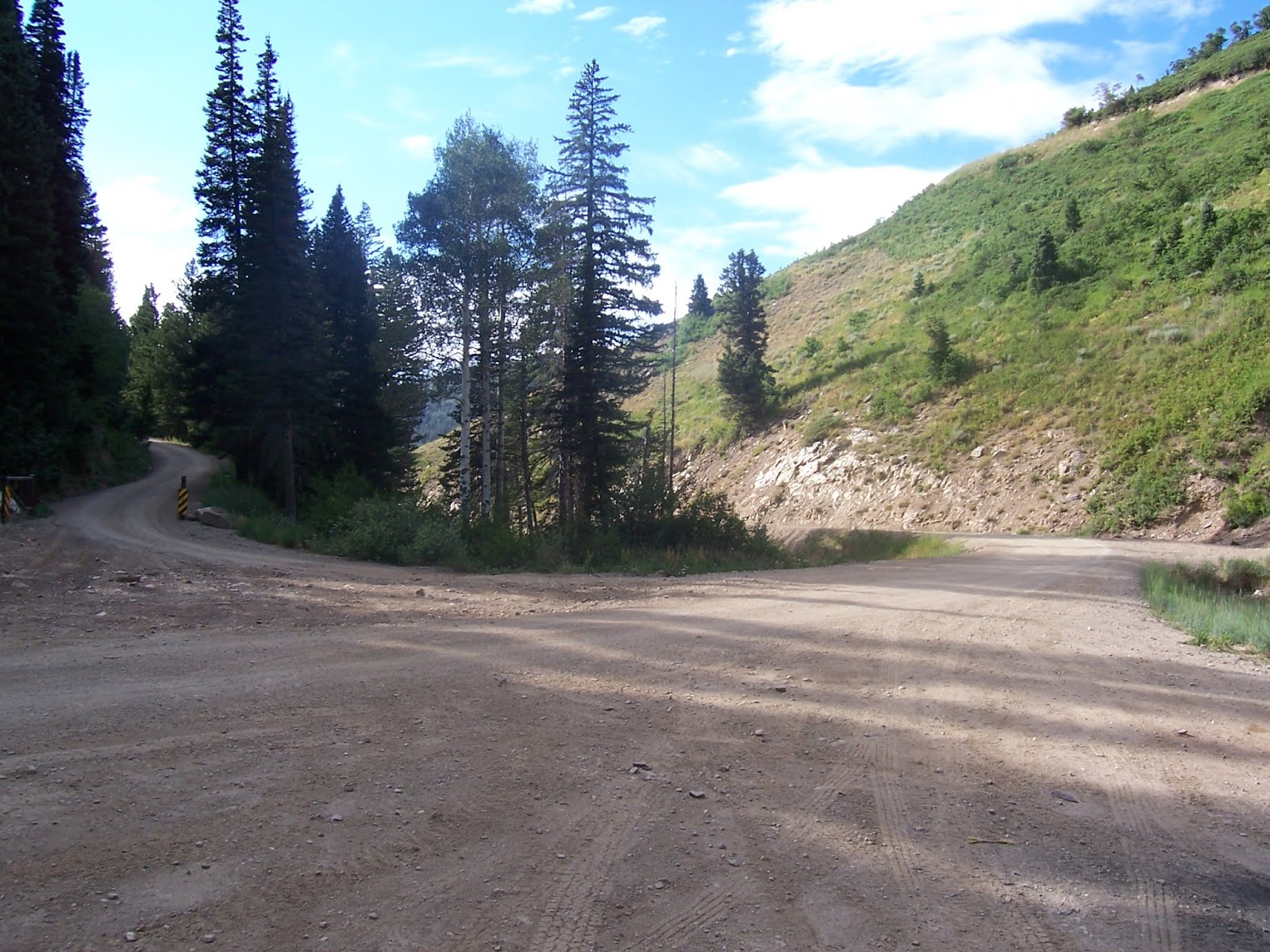
THE 5-mile dirt road from the top of Farmington Canyon to Francis Peak was NOT built in the late 1950s when the Francis Peak radar station was constructed. It was built more than 20 years earlier by the CCC (Civilian Conservation Corps) and was completed in 1938.
According to the Davis County Clipper of Sept. 2, 1938, men of the CCC Company No. 940 constructed the five mile road in a two year project. It started as 12-feet wide and the U.S. Forest Service widened it to 22 feet.

                                  The junction at the top of Farmington Canyon.


"It will open up the scenic beauty around Francis Peak," the Clipper story stated.
The initial purpose of the road was to support erosion control. That's because the Farmington area suffered devastating floods in the 1920s, from overgrazing and also sudden cloud bursts.

                         An upper section of the road through Farmington Canyon.


                                              The northern radar dome atop Francis Peak.

-That same year, the Salt Lake Telegram newspaper heralded the completion of the entire mountain road, with the headline, "Farmington and Bountiful connected by scenic loop" was an Aug. 31, 1938 headline in the Telegram. This 17 mile stretch was also constructed by the CCC. (The side road north of Francis Peak was a connecting route.)
The road, today's "Skyline Drive," was begun in 1933 by the CCC for erosion control and access. The steepest portion of the road is through Farmington Canyon and that section is 7.5 miles long.
In order to avoid drilling through rock, the Canyon road included two bridges.
The Bountiful Peak Campground and Picnic Area is about one mile south of the top of Farmington Canyon. That facility was dedicated on Aug. 22, 1941, according to the Clipper of Oct. 15, 1941.

                          Note the switchbacks up the north side of Farmington Canyon.

-It didn't happen, but in 1940, plans were proposed to connect the Davis County mountain road with Emigration Canyon. The Salt Lake Telegram of March 27, 1940, reported the proposal by the U.S. Forest Service. Likely, the United State's entrance into World War II at the end of 1941 doomed that ambitious plan.
However, that tentative road was surveyed as 29 miles long and run along the edge of City Creek and end at Little Mountain in Emigration Canyon. (Originally, the road was to go all the way to Parley's Canyon.)

                             A view from Layton City toward Francis Peak.