Showing posts with label Ogden Canyon. Show all posts

Wednesday, July 11, 2018

Another 'Sardine Canyon' is also found in northern Utah -- Up Ogden Canyon

                                     The late Hermitage Inn in Ogden Canyon.


IT has to be more than a coincidence that both of the Sardine named canyons in the entire United States are located in the State of Utah .... and only some 30 miles apart.
There's the well-known Sardine Canyon along the well-traveled route of U.S. Highway 89, between Brigham City and Logan.
And, then there's the little known and hardly visible Sardine Canyon, located off Ogden Canyon, south of the Alaskan Inn and not far from where the original historic Hermitage Inn was found.
The Hermitage hotel opened in August of 1905. It boasted 25 rooms and cost some $30,000 to build. Soon after, a second story was added to the motel, with another hotel 16 rooms. Horse-drawn buggies carried passengers to the resort before a rail line was built in Ogden Canyon.


Trout and chicken dinners are the specialty of the rustic Hermitage. Boating was also popular on the Ogden area, near the hotel. (Two of the owners' own children drowned in a boating accident there.)
The Hermitage had a short run of some 34 years. An explosion and fire leveled the resort in January of 1939 and it was never rebuilt.
-In fact, the Hermitage received all of its original water from Sardine Canyon, according to the Ogden Daily Standard of Nov. 5, 1912.


William "Billy" Wilson, who built the Hermitage out of lumber in the area, also made a dam in Sardine Canyon to supply his business with ample, yet independent water, according to the Standard of May 17, 1912.
-This other Sardine Canyon was also famous for another event -- it was the site of the first open air (non-Mormon) Christian religious services in Utah. According to the Ogden Daily Standard of May 30, 1913.
Christians from Brigham City to Salt Lake City gathered at the Hermitage and then traveled up the trail to the nearby Sardine Canyon for their outdoor services. 


                    The Alaskan Inn, about half-way up Ogden Canyon.


-Today, part of Sardine Canyon, as well as Sardine Peak, are accessed by a popular mountain bike loop trail.
-The "why" the two canyons have the same name is somewhat of a mystery.  The Ogden Canyon Sardine version is indeed a narrow and small canyon, deserving of a sardine-can type title.
The Highway 89 Sardine Canyon name has a lengthy history that is explored in detail elsewhere on this blog.

        The other Sardine Canyon, along Highway 89, between Brigham City and Logan.

-Historic black and white photos are from "History of Ogden, Utah in Old Post Cards," by D. Boyd Crawford.

The Scoop on Wheeler Canyon, off Ogden Canyon

    The mouth of Wheeler Canyon, at the far east end of Ogden Canyon.  Photo by Whitney Arave.

WHEELER CANYON is the first canyon below Pineview Dam. It is southwest of the Dam itself.
Today Wheeler Canyon is best known as a mountain bicycle trail. However, use of the canyon dates back to 1866. Levi Wheeler, an Ogden area pioneer, located a sawmill on the stream in Wheeler Canyon that year and he is the origin of its name.
The sawmill materials had been hauled across the plains  to Utah. Calvin Wheeler, son of Levi, told the Ogden Daily Standard Newspaper of Sept. 20, 1919 about the origin of the canyon's name. He also said that when he lived near the canyon in the 1860s, he recalled traveling some 16 miles from Huntsville to kill 16 elk for food, to get through the winter.
-Also, a century ago, the area in Ogden Canyon near Wheeler Canyon's mouth was called "Pine View" and hence the name of the today's dam there.
-A Boy Scout troop of 24 boys, led by Scoutmaster Charles E. Fisk, hiked up Wheeler Canyon in the fall of 1922. They then climbed to the top of Mount Ogden -- with no trail to follow. Then, the descended down the left-hand fork of Taylor Canyon -- again with no trail to follow. Despite encountering cliffs and two inches of snow, there were no mishaps.
The Scouts reported seeing lots of blue grouse and willow grouse and even the tracks of a wolf. They returned to Ogden City after a 13-hour hike that covered some 25 miles. (-From Ogden Daily Standard, Oct. 23, 1922.)


-In the 1920s and up until the construction of Pineview Dam, there used to be the "Power Dam" at the head of Wheeler Canyon. This dam was built in 1897 and was some 40 feet deep and 300 feet long.
Ogden City got most of its drinking water from the artesian wells in Ogden Valley and also from Coldwater Canyon -- before Pineview Dam came along, in 1937.

Thursday, February 1, 2018

When City Creek Canyon was heralded as a resort; Plus, mosquitoes in Utah’s early decades


                            On the western lip of City Creek Canyon, looking south.

CITY Creek Canyon is one of the natural gems of Salt Lake City. And, “City Creek as a resort” was an August 12, 1883 headline in the Salt Lake Herald.
The story stated that Big Cottonwood Canyon had been the camping resort of choice to date, though it is a long day trip to access it from downtown.
“But City Creek is right at your door; a man can attend to business up to 5 or 6 o’clock and ride or drive up the pleasant canyon six or seven miles in three-quarters of an hour, and remain overnight at a place where blankets are essential to comfort, where the fly doth not buzz and the mosquito settles down with the mantles or night; and the next morning he enjoys a pleasant ride down the cool canyon, where the birds are singing, the green boughs waiving, the waters murmuring and everything is quiet and calculated to assist the proper digestion of bacon, ham and beans.”

                   Looking down into the south end of City Creek Canyon.

“It is a very cheap luxury,” the story also stated, and one of the best ways for bracing against the withering heat of summer.
-Mosquitoes didn’t earn much, if any, press in Salt Lake City’s earliest decades. That may be because the pesky insects were only considered a small nuisance among the ruggedness of pioneer life.
One of the first references of mosquitoes was in the Deseret News on August 9, 1871 under the headline of “How mosquitoes bite.”
Surprisingly, the story states that after mosquitoes suck a person’s blood, they release poison into the wound.
“If he (a mosquito) were as big as a kitten, and his poison as strong in proportion, a ‘bite’ from him would kill us,” the story stated.
(Today we know mosquitoes do suck a human’s blood, but release not poison, but an anti-coagulant
into a wound – and the possibility of them transferring disease, like the West Nile Virus, is a significant danger.)
The Salt Lake Tribune of June 16, 1873 humorously stated, “Mosquito shooting is a favorite pastime in the lower wards” of Salt Lake City.
Indeed, the July 8, 1875 Tribune reported on an outdoor outing to Ogden by Masons at a beautiful grove. It stated, “after reaching the grove, divided time between dancing, croquet, partaking of bounteous lunch and fighting the festive mosquito.”
Next, the Deseret News of August 15, 1877 printed a story, “The Mosquito of the Yellowstone.” The entire story emphasized how bad that the future Yellowstone National Park was infested with the peskiest flying insects ever.
“Anyone who has ever been bitten by a Yellowstone mosquito will not need to be told how he feels … Seriously, the soldiers station in that country find life almost unendurable at this season of the year.”
-In another historical tidbit, a severe summer storm on July 28, 1904 knocked out power during some of the prime evening hours in downtown Salt Lake City. The Deseret Evening News of July 31, 1897 reported that at 5:45 p.m. the power went out. All street cars stopped and electric lights were out and a concert in the Salt Lake Tabernacle was half-way in progress and had to be halted. Then a downpour struck and pedestrians ran for shelter. The outage lasted by 20 minutes in some locations, but far longer in others.

                                              Ogden Canyon in the 1920s.
-Ogden Canyon was the site of a huge explosion on July 30, 1897 at an old powder mill. The Deseret Evening News of July 31, 1897 had the headline, “A terrific explosion.”
There was one victim, William Bowlder, who was described as a “charred and blistered mass of flesh.” The roof of the building was blown 100 feet away and Bowdler was hurled 15 feet from the site. The structure was a total loss.
-Finally, the same Deseret Evening News of 1897 also reported that a young man in Weber County was bitten by a rattlesnake and was slowly recovering. Said to be a “snake charmer” of sorts, who experimented with snakes, the bite was accidental. The bite happened in the community of “Coal Patch,” east of Pleasant View. The man, named Johns, was said to not want to handle snakes anymore.


Monday, October 3, 2016

‘The Oaks,’ An Ogden Canyon eatery beginning in 1903 -- Before the Hermitage


By Lynn Arave

THE Oaks is a delightful little restaurant in Ogden Canyon and is the oldest operating business in the Canyon -- even predating the Hermitage.
The Oaks is often stated as having begun in 1907, but it is actually even older.
"The Oak's Summer Resort, A pleasant retreat in Ogden Canyon discovered by City officials today" was a June 10, 1903 headline in the Ogden Standard Examiner.
A group of Ogden leaders on a retreat found themselves "seated beneath the shady trees at 'The Oaks,' as beautiful, clean and neat a spot as can be found anywhere in the canyon, conducted by Potter Bros. of Ogden, Ginger ale, lemonade and soda water, with an occasional stick in it, can be procured here at the usual prices," according to the Standard story.
The City leaders also noticed how well the grounds were kept at The Oaks, at a feast there "on short notice" and also discovered "At this resort, no one under the influence of liquor can be served."


                                      The Oaks in the 1910s.
              -Photo from the Utah Division of State History

In the July 31, 1903 Standard-Examiner was a report of some Ogden sisters who picnicked at The Oaks.
On Aug. 6, 1903, the first outing of the Ogden Automobile Club was a drive to The Oaks and a banquet there, according to the Standard-Examiner. There were tables and meals served in 1903 at The Oaks.
The Standard-Examiner of Sept. 5, 1905 stated that a boxer, Mike Schreck, was getting in shape for a big fight and was training at The Oaks.
The Standard of Sept. 12, 1905 reported that it was the Canyon Resort Company that operated The Oaks and the business was making plans for a new restaurant and cottages. Plans also included a new system of roads through the place and a trail up the mountainside.  

                        The Oaks today, very shady and casual.

"Big time at The Oaks. Celebration at Ogden Canyon a huge success. Great crowd gathered at the popular resort and they had the time of their lives" (at “Valley Day”) was an Aug. 20, 1907 Standard headline. (So, it may be that The Oaks simply hit its stride in popularity in 1907 …)
 "Valley Day" was some sort of Ogden Valley celebration and that was what was being celebrated at The Oaks. Residents from Eden, Liberty and Huntsville attended.
(The Standard of Aug. 5, 1904 had also reported "Valley Day" being celebrate at The Oaks that year too.) 
"Lightning hits The Oaks Resort" was a Sept. 1, 1909 headline in the Standard-Examiner. A resort guest, Miss Bertha Parkinson, was struck by lightning at about 5 p.m. on Aug. 31 as a storm rolled by. The efforts of a Dr. Woolley and others are credited in saving her, as she was believed to have taken the full force of the bolt and was seemingly dead for a time.
The June 26, 1910 Standard-Examiner stated that The Oaks had improved its camping grounds, erected some new cottages and was still famous for the chicken and trout dinners served in its cafe.


                          The outside waiting area at the modern Oaks.


The Oak's own history states that the original Oaks was about a mile from its current location and built by C.S. Potter. It doesn't say if that was east or west, though. It was in 1933 that The Oaks moved to its current location -- higher ground -- to avoid frequent flooding from the Ogden River.
The Oaks was purchased in 1981 by Keith and Belinda Rounkles. They renovated the place into a full service eatery, serving breakfast, lunch and dinner.

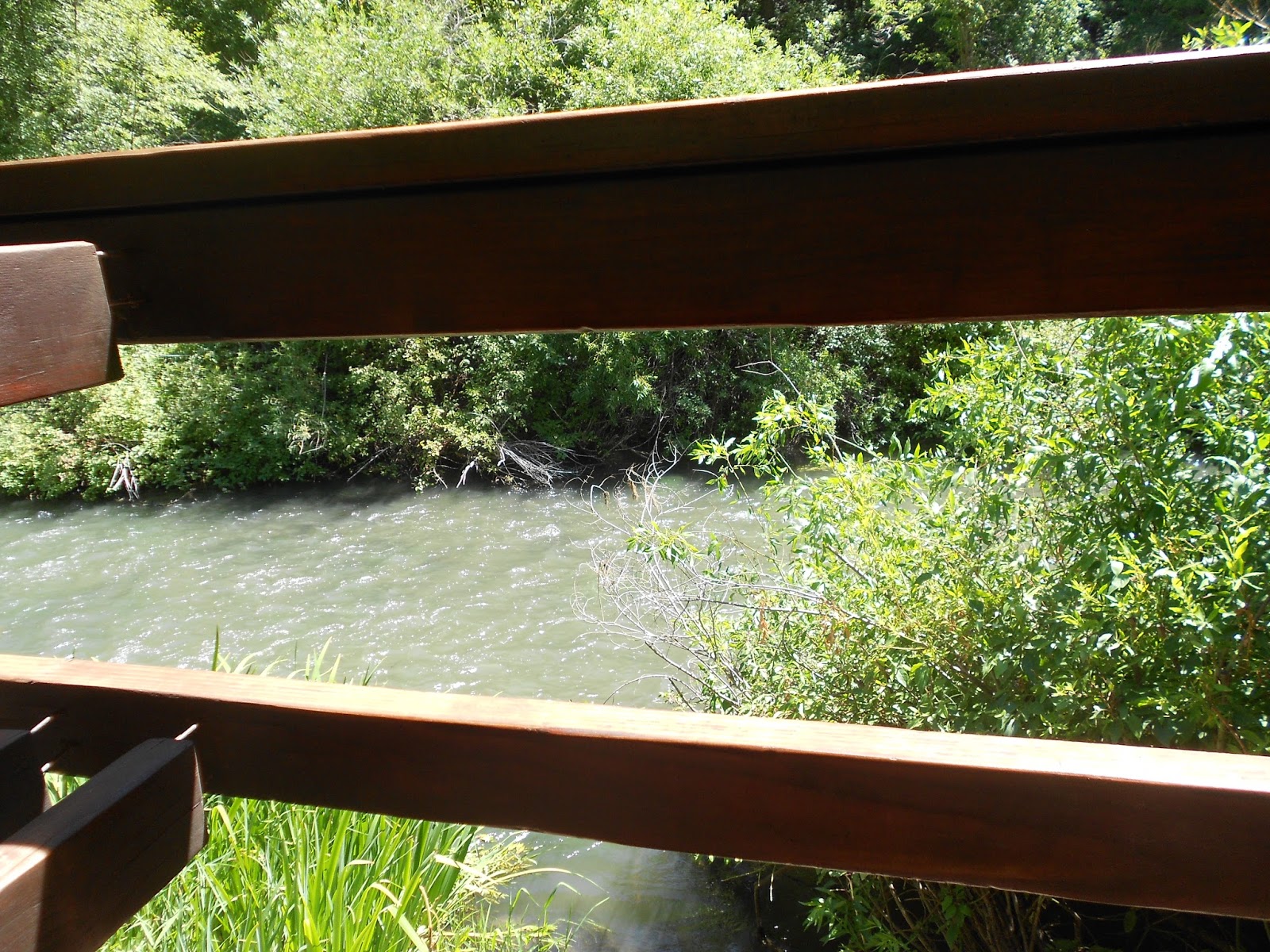
                    A view right from an eating table to the Ogden River.

In 1994, the Rounkles purchased 160 surrounding acres to ensure that the surrounding area remains more natural.
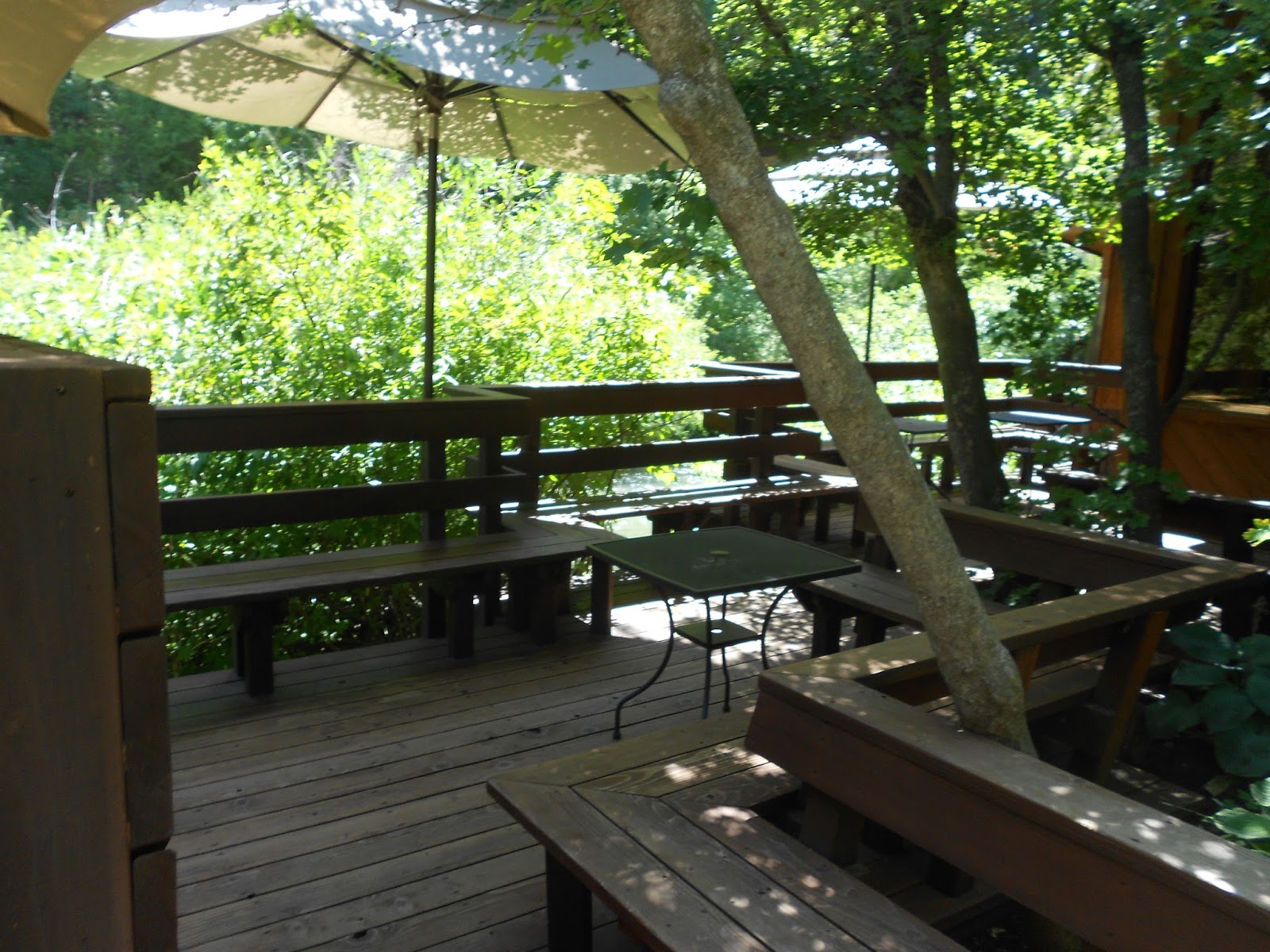
Nestled in some oak and other trees along side of the Ogden River, this restaurant has some indoor seating, but an outdoor table next to the Ogden River in the summer season may require a wait.

The Oaks has reopened in November of 2025 under new ownership, after 4 years of closure, since 2021.

-The Oaks, 750 Ogden Canyon, was located four miles, or about 7 minutes up the Canyon. Take 12


                               A rugged peak in Ogden Canyon to the north of the Oaks.


Thursday, September 17, 2015

The Oaks of Ogden Canyon began in 1903, not 1907

                            The Oaks restaurant sign today.

THE Oaks is a delightful little restaurant in Ogden Canyon, Utah. It WAS definitely the OLDEST operating business in Ogden Canyon for many decades. Then, it closed for 4 years, until late 2025, with a a new owner.

-However, The Oak's own history sells itself short and contains some shortcomings.
The Oaks is stated as having begun in 1907 in a history that's on the restaurant's own menus and also on the restaurant's walls.
Yet, "The Oak's Summer Resort, A pleasant retreat in Ogden Canyon discovered by City officials today" was a June 10, 1903 headline in the Ogden Standard Examiner.
That means the place started AT LEAST four years earlier.
A group of Ogden leaders on a retreat found themselves "seated beneath the shady trees at 'The Oaks,' as beautiful, clean and neat a spot as can be found anywhere in the canyon, conducted by Potter Bros.  of Ogden, Ginger ale, lemonade and soda water,with an occasional stick in it, can be procured here at the usual prices," according to the Standard story.
The City leaders also noticed how well the grounds were kept at The Oaks, at a feast there "on short notice" and also discovered "At this resort, no one under the influence of liquor can be served."
The Ogden City leaders noted in the story that "the greatest trouble in the canyon is from the outing parties that take with them more liquor than the parties can well navigate with."


         The Ogden River is just a step away from some of the tables at The Oaks today.

-In the July 31, 1903 Standard-Examiner was a report of some Ogden sisters who picnicked at The Oaks.
-On Aug. 6, 1903, the first outing of the Ogden Automobile Club was a drive to The Oaks and a banquet there, according to the Standard-Examiner. There were tables and meals served in 1903 at The Oaks..
-The Standard-Examiner of Sept. 5, 1905 stated that a boxer, Mike Schreck, was getting in shape for a big fight and was training at The Oaks.
-The Standard of Sept. 12, 1905 reported that it was the Canyon Resort Company that operated The Oaks and the business was making plans for a new restaurant and cottages. Plans also included a new system of roads through the place and a trail up the mountainside.  


                                 This view of a craggy mountain is visible at The Oaks.

-"Big time at The Oaks. Celebration at Ogden Canyon a huge success. Great crowd gathered at the popular resort and they had the time of their lives" was an Aug. 20, 1907 Standard headline. (So, it may be that The Oaks hit is stride in popularity in 1907, though).  "Valley Day" was some sort of Ogden Valley celebration and that was what was being celebrated at The Oaks. Residents from Eden, Liberty and Huntsville attended.
(The Standard of Aug. 5, 1904 had also reported "Valley Day" being celebrate at The Oaks that year too.) 
-A Japanese official visited Ogden in the summer of 1908 and had a special reception and dinner at The Oaks, according to the Standard-Examiner of Aug. 13, 1908.
-"Lightning hits The Oaks Resort" was a Sept. 1, 1909 headline in the Standard-Examiner. A resort guest, Miss Bertha Parkinson, was struck by lightning at about 5 p.m. on Aug. 31 as a storm rolled by. The efforts of a Dr. Woolley and others are credited in saving her, as she was believed to have taken the full force of the bolt and was seemingly dead for a time.
-The June 26, 1910 Standard-Examiner stated that The Oaks had improved its camping grounds, erected some new cottages and was still famous for the chicken and trout dinners served in its cafe.
-The Oak's own history states that the original Oaks was about a mile from its current location and built by C.S. Potter. It doesn't say if that was east or west, though. It was in 1933 that The Oaks moved to its current location -- higher ground -- to avoid frequent flooding from the Ogden River.
The Oaks was purchased in 1981 by Keith and Belinda Rounkles. They renovated the place into a full service eatery, serving breakfast, lunch and dinner.
-In 1994, the Rounkles purchased 120 surrounding acres to ensure that the area remains the same, private and secluded retreat, except for the busy highway nearby.


Ogden Canyon: From echoes to a 'Z' to snakes

                          Ogden Canyon is most rugged at its west end.

OGDEN Canyon has undoubtedly changed a lot over the decades. A wide road was built through the Canyon and at one time there was a trolley line in the Canyon. However, as recent as a century ago, there used to be a perfect echo location in a spot above the Canyon; and in another location, there was the letter “Z” plainly visible.
ECHO: This ideal acoustic location was in a small side canyon, high above and near the original Hermitage Inn. According to the Ogden Standard-Examiner of July 10, 1911, John Leavitt of Plain City and some friends stumbled across the site.
“Those in the party say that the echoes heard from the voice of a person standing at one point in the narrow canyon are almost supernatural,” the Standard reported.
The men apparently experimented there and found the exact spot where even a whisper “was made to sound as if a cave of winds had been unloosed.”
The men also suspected that a small cave, nearby, that went about 10 feet into the mountainside, as well as a 20-foot-long rock jutting out of the hillside, were probably responsible for the acoustic effect.

            Today's Alaskan Inn, near the site of the original Hermitage, now gone.

THE GIANT LETTER Z: According to the Ogden Standard-Examiner of April 19, 1925, this letter was visible in rock up Wheeler Canyon. A century ago, it was best viewed about 100 yards south of the hotel in that area and by looking northward. A U.S. Geologic Survey in the area in 1871 also reported seeing the giant Z formation.

SNAKE EXTERMINATION SOCIETY: The Standard-Examiner of July 27, 1893 reported that a group of young women from Ogden had organized a snake extermination society, tired of being plagued by the reptiles in beautiful Ogden Canyon.

Legend of the last buffalo in Ogden

                                                            Buffalo on Antelope Island.


THE Indian Trail above the south side of the entrance into Ogden Canyon is a historic path, the route used by Native Americans to reach Ogden Valley – especially when the Ogden River levels were high. Yet, the Indian Trail also ties in with the demise of the last reported buffalo herd in today’s Ogden city boundaries.
According to the Ogden Standard-Examiner of April 19, 1925, the first pioneers in Ogden reported that the last herd of buffalo in the region perished when they tried to take the Indian Trail in deep snow to reach Ogden Valley.
“For many years the bones of the buffalo could be seen scattered along the trail,” the newspaper story stated.

                             The Indian Trail as it heads toward the mouth of Ogden Canyon.

Wednesday, September 16, 2015

Before Pineview Dam there was the Wheeler Dam


                       Pineview Dam.          Photo by Whitney Arave


IN 1898, the first major dam east of Ogden was the Wheeler Canyon Dam. Located west of today’s Pineview Dam, was some 300 feet long and about 40 feet deep.
According to the Ogden Standard-Examiner of June 30, 1898, the Pioneer Power Company built the dam of masonry and concrete.
Work on this dam had started in 1897.
The Standard-Examiner of Sept. 8, 1905 reported than an engineer had proposed that a new dam be built to the east of Wheeler Dam, near the Shanghai River Bridge. That was amazingly close to where Pine View Dam was eventually constructed decades later.
After that, the South Fork of the Ogden River was surveyed and even bull dozed somewhat for a possible dam site that never happened, despite several decades of trying.
According to the Standard-Examiner of Sept. 5, 1910, another dam was proposed to be built in Coldwater Canyon. 

    All that's left of the Coldwater Canyon water system today is a small shack and some old piping.


However, that never happened and a 10-inch water that had been installed in Coldwater Canyon in 1909 was used for many years to supplement the Ogden City water supply.


                                         The replica lime kiln near Coldwater Canyon today.


-The lime kiln in Coldwater Canyon was reported operating again, according to the July 20, 1924 Standard-Examiner. After a three-decade lapse, the kiln was working again and even a road was built to the site.
(Today, the lime kiln is commemorated along the Coldwater Canyon trail as a pioneer industry, complete with a rebuilding of a kiln.)


-NOTE: The author, Lynn Arave, is available to speak to groups, clubs, classes or other organizations about Utah history at no charge. He can be contacted by email at: lynnarave@comcast.net


Thursday, September 18, 2014

Ogden Canyon’s trolley rolled from 1909-1932

                                                The mouth of Ogden Canyon today.

OGDEN area residents loved their Ogden Canyon enough to warrant a railroad there. And, at one time it was hoped the rails there would access Utah’s “summer capitol,” had that suggested building been built.
An electric railroad trolley from Ogden to Huntsville opened in July of 1915.
A partial Ogden Canyon railroad had already been operating to the Hermitage Resort since 1909, since the canyon and its resorts were viewed as great possible revenue producers.
For almost a quarter of a century, this electrified rail line offered reliable transportation into Ogden Canyon and for 17 of those years it traveled from the Ogden Depot to Huntsville, by way of Eden.
There was no Pineview Dam in those days to detour around, but the line required five steel bridges. It was also quite the engineering marvel, having to hug the canyon walls through the “Narrows” in the lower canyon and rock cliffs further up the canyon – some up to 100 feet high – had to be removed for rail construction.
Just three rugged miles of railway construction in Ogden Canyon cost $100,000 (that’s the equivalent of $2.4 million in 2014 dollar value). Concrete and steel helped hold the rail grade in place, often running next to the wagon road in the canyon.
According to the Standard-Examiner, some 100 men were employed constructing the line in 1912.
There were also complicated right of way issues to deal with. 
By July of 1912, the Standard on July 18 reported that the Ogden Rapid Transit Company had decided to change its route in the upper canyon. Instead of following the south side of the river, it switched to the north side – even though that meant abandoning some of the old line and conducting new surveys.
“This is one of the most important trolley line extensions undertaken …” the Standard reported. “This opening of Ogden Valley to beet culture and more intensive cultivation in every way, promises to build up a much larger farming population, which directly must benefit the city. It will not be many years when beets, hay, grain and dairy products will be shipped to Ogden by the trainload,” the 1912 story concluded.
Early on, Simon Bamberger, who owned the Bamberger railroad (and who would later become Utah’s fourth governor) and who also owned the Heritage, desired a rail line to his resort.
Ogden Rapid Transit wanted such a line too and had the much earlier start, but for a time, both railroads were creating separate grades in Ogden Canyon. Eventually Bamberger withdrew and his section of completed grade became part of the public road though Ogden Canyon.
The trolley line carried some 7,000 passengers during the fourth of July holiday of 1910.
By May of 1913 and through the warm weather season, the Trolley to the Hermitage offered cars once an hour. The first car left Ogden at 10:30 a.m. and the last one at 7:30 p.m.
The first trolley cars used carried 46 passengers and had both smoking compartments and toilets.
Besides high hopes for farming and shipping with the trolley line, there was also an effort afoot in 1911-1912 to try and convince the State of Utah to have a “summer capitol” in beautiful Ogden Valley, about three miles southeast of Huntsville.
Of course, that never happened, but the Ogden Rapid Transit Company was prepared to extend its trolley line there.
P.L . Orth, secretary of the Huntsville Improvement Club, was pushing the summer capitol drive and declared in a Feb. 28, 1912 Standard story that, “Huntsville no longer sleeps.”
Orth also wanted to utilize warm spring waters in the valley to encourage more development there.
Back to the trolley line  -- By 1913, several trolleys used were modified to be open roof observation cars. 
The line also weathered lots of snowslides over the years. For example, the Standard on Feb. 18, 1926 reported that three avalanches had buried the tracks in Ogden Canyon. It took almost two full days to clear the tracks and restore full service again.
However, it wasn’t snow or even the advent of the automobile that doomed the Ogden Canyon line. It was the severe flooding in the canyon during 1932 that badly damaged the tracks. 
In September of 1932, regulatory approval was given to halt rail service and remove the tracks. Buses and trucks now used the canyon highway to compensate for the lack of a trolley.
The old rails in the upper section were removed during 1934, when Pineview Dam construction began. The rails in Ogden Canyon were initially used to transport material to build Pineview. Then, they too were removed to end the era of iron rails in Ogden Canyon.
-Some source material came from utahrails.net, by Don Strack.

(-Originally published on Sept. 20, 2014 in the Ogden Standard-Examiner.)

-NOTE: The author, Lynn Arave, is available to speak to groups, clubs, classes or other organizations about Utah history at no charge. He can be contacted by email at: lynnarave@comcast.net  


Saturday, June 21, 2014

Ogden Canyon: A ‘royal gorge’ in 1887

                                              The mouth of Ogden Canyon                          Photo by Whitney Arave.

By Lynn Arave                            

OGDEN area residents were fascinated with Ogden Canyon in the late 19th Century. Whereas today the Canyon probably just seems like a conduit to Pineview Reservoir, or the ski resorts, or the South Fork campgrounds, it was practically worshipped 127 years ago and viewed as a natural retreat of its own.
“The chasm cut by nature’s hand through the Wasatch Range. A tribute to Ogden Canyon’s Grandeur.  Swift, swift river. How it roars and foams in madness. Then sings in peace.  Another royal gorge – Sublime scenery of a superb canyon – Something the world should see,” was a May 24, 1887 lengthy headline in the Ogden Standard-Examiner.
The story mentions passing “the narrows” in the canyon. By that, I assume, the narrow opening at the start of the canyon (and widened in modern years).
Also mentioned is passing by the warm, medicinal springs of “Kiesel, Carnahan and Anderson.”
The recommendation is next to stop at Wilson’s Mills, tie up the horse and climb a nearby hill to gain a perspective of looking down the chasm.
“Cap Rock” was mentioned as another highlight, with one large rock leaning on another. (No modern reference could be found to this feature, so it may no longer exist in the Canyon.)
Finally, the story mentions a large cave, “often been compared with the Salt Lake Tabernacle,” with a “huge roof of overhanging-rock spreading its rounded rocky canopy over the astonished visitor.” (Again, what this is talking about is unclear today.)
“It is a delightful, healthy, pretty grand place,” the article concluded of Ogden Canyon.
However, 24 years later, there was a dark side to Ogden Canyon – flooding.


“The Hermitage is isolated and buildings on the lowlands are endangered – County bridge at the mouth of the canyon may go down – Homes in the City flooded,” was a Jan. 31, 1911 headline in the Standard.
The Ogden River was on a rampage that winter and even the bridge over Washington Avenue, between 19th and 20th streets was in jeopardy.
Ogden Canyon was also struggling with rumors in 1895 of plentiful rattlesnakes and hobos living there. An Aug. 24, 1895 Standard reporter said all the dynamiting being done in the Canyon that summer surely had scared all the reptiles away. And, the writer said he found no evidence of vagabonds living in the Canyon.
A July 12, 1899 Standard story claimed visitors to Ogden Canyon never numbered less than 1,500 people on a typical Sunday in summer. However, for their benefit, the road to the mouth of the Canyon needs better sprinkling, to avoid dust and more upkeep overall.
By early 1901, the mouth of the Canyon was being dynamited, to provide better access.
On Feb. 12, 1913, a fire destroyed the sanitarium at the mouth of Ogden Canyon. A forerunner to today’s Rainbow Gardens, a Standard story reported the place had “been considered as one of Ogden’s most popular health and bathing resorts.”
Heated by coal stoves, the building was razed to the ground. Only the private baths in the rear of the main building were left standing, with their brick walls.
The building’s loss was placed at $35,000, lowered to $21,000 with insurance.
Almost a hundred years ago (1918), there was also a different “Pineview” east of Ogden. In Ogden Canyon there was Pineview the hotel, with cottages, boating, fishing, trout and chicken dinners, hot coffee, sandwiches and refreshments.

(-Originally published by Lynn Arave in the Ogden Standard-Examiner, June 20, 2014.)


Above/Below: From "History of Ogden, Utah in Old Post Cards," by D. Boyd Crawford, used with permission.


-NOTE: The author, Lynn Arave, is available to speak to groups, clubs, classes or other organizations about Utah history at no charge. He can be contacted by email at: lynnarave@comcast.net  


Friday, April 18, 2014

Ogden Canyon’s ‘Bridal Veil Falls’

By Lynn Arave

Ogdenites were simply fascinated with waterfalls around the end of the 19th Century -- like the one in Waterfall Canyon (featured the two previous weeks in this column), so much so that they created their own water drop, near the mouth of Ogden Canyon, Utah.
Indeed the June 28, 1912 Standard referred to the Ogden Canyon waterfall as the “Bridal Veil Falls of Ogden.” That year, the Western Weekly publication had a full-page illustration of the waterfall at the mouth of Ogden Canyon. It didn’t matter that the falls were manmade, they were still a solid tourist attraction and one of the first things visitors to Ogden Canyon saw.
“For years this beautiful waterfall has arrested the attention of sojourners in Ogden Canyon and it can be said that no other bit of scenic charm in the Wasatch ranger remains longer in the memory of the visitor than does this fairy bridal veil as it leaps from a beetling cliff 800 feet above the roadway, dissipating itself into fluffy clouds of vapor ere it has fallen one-half the distance to the stream below,” the Standard story stated.
The story then explained an old, lengthy Ute Indian tale, “The Leap of Little Swan,” as the fanciful legend of how the artificial cascade “began,” that delighted thousands of summer visitors to Ogden Canyon.
The Ogden Canyon falls were created in the late 1880s when Fred Packard of Utah Power & Light conceived the idea of an artificial water cascade there. He changed a cracked tunnel to an open waterway through the rocks with a giant blast of dynamite.
The falls served two necessary purposes: they prevented a vacuum forming in the pipeline and they also managed overflow water that had to be turned back in the Ogden River above certain irrigation canals.
Long before Rainbow Gardens came along at the mouth of Ogden Canyon, “Rainbow Cataract” was what a Standard article on March 9, 1889 called the artificial falls near the mouth of the canyon.
By 1907, a November 5th Standard article called it the largest waterfall in the state and noted that water was flowing 12 months a year there, dropping some 400 feet.
However, that year-round flow soon created “a frigid threatening monster,” according to one Standard report. On Dec. 23, 1909, a huge icicle had formed around the falls, threatening travelers and spectators below. An avalanche of ice and snow destroyed the regular bridge across the Ogden River at the mouth of Ogden Canyon. Travelers and teams were having to use the separate Rapid Transit Trolley bridge to access the canyon. The waterfall flow was cut off. A temporary bridge was later made and the icicle was blasted away in small patches.
In later years, changes were made so that such ice buildup in winter was kept to a minimum.
“Waterfall is again an attraction in Canyon” was an Aug. 8, 1917 Standard headline. Broken pipeline repairs by Utah Power has halted the waterfall for several weeks, “a source of regret to many tourists who have seen photographs of the beautiful bridal veils and anticipated seeing this novelty in the canyon.”

(-Written by Lynn Arave and originally published in the Ogden Standard-Examiner on April 18, 2014.)


-NOTE: The author, Lynn Arave, is available to speak to groups, clubs, classes or other organizations about Utah history at no charge. He can be contacted by email at: lynnarave@comcast.net  


Saturday, January 4, 2014

Ogden's old artesian well park gone, but its waters still flow ...


(From "History of Ogden, Utah in Old Post Cards," by D. Boyd Crawford, used with permission.)

By Lynn Arave
  
WATER has always been a centerpiece of Ogden Valley.
Before the days of Pineview Reservoir (pre-mid-1930s), at the west end of the valley there were green meadows and many flowing artesian wells.
When the pioneers arrived in force in the 1860s, cattle would roam the area and ranchers noticed cool waters bubbling up from the ground, likely near where the west end of Pineview Reservoir is today.
In 1889, the first artesian well was drilled 84 feet down. It provided 40 gallons a minute.
Between then and 1935, a total of 51 wells were drilled, with 48 of them flowing. Average depth of the wells was 135 feet, but the deepest went some 600 feet down.
Ogden City drilled the wells to augment its water supply. Ogden was already receiving water from the Weber and Ogden rivers, plus from Taylor, Waterfall and Strongs canyons.
In 1925, there was a temporary sand problem in one of the new wells drilled.
However, the 1920s heralded the artesian wells as a new tourist destination each summer. The July 16,1924 Standard Examiner reported scores of inquires a day to Ogden City from all over the nation about its artesian well park.
Indeed, that summer, the Ogden Chamber of Commerce would regularly shuttle tourists to the wells. It also mailed out some 10,000 booklets that summer on the wells all over the country as a promotion.


  The west end of Pineview Dam, near where the old Artesian Well Park likely would have been.
                                                                                                                  Photo by Whitney Arave.

“Take a cool ride through Ogden Canyon stopping at Hermitage Inn and Park Pineview and Artesian Wells” was part of an advertisement in 1926 in the Standard-Examiner.
Even before the first deep well was drilled, there were some types of simpler water fountains there. The Standard-Examiner on March 25, 1888 reported: “It is worth the pains of the trip (up Ogden Canyon) to get a drink from these fountains and enjoy the fresh, invigorating mountain air.”
The city planted grass, trees and shrubs in 1922 at the well park and used cement to create standard circular fountains there. You didn’t visit Ogden Canyon,or Ogden Valley without taking a cool drink from one of the flowing wells.
The artesian wells soon provided 811,000 gallons a minute, or 16 million gallons of water a day. The water was piped to Ogden in a redwood pipe, used for some 50 years.
The artesian wells soon formed Artesian Well Park, a refreshing summer spot for residents and tourists.
August of 1933 was the only dark side to the artestian wells, as some sort of contamination plagued the well water part of that summer.
When Pineview Reservoir was filled in 1937, the artesian wells were capped and piped out to Ogden Canyon, to continue to supply drinking water to area residents.
By 1956, two-thirds of Ogden’s water, some 20 million gallons a day, were from the artesian wells.
However, it was realized in April of 1968 that after three decades, the 70-foot-deep reservoir water and accompanying pressures had damaged the piping and caused untreated Pineview water to seep into the drinking water pipes. This turned the water red and created slime and odor problems with the water.
All the Pineview water was then chlorinated for health reasons in that emergency, though that also killed most of the trout in the waters.
Pineview Dam was then drained and the old artesian wells were capped. From December of 1970 to May of 1971, six new and larger artesian wells were dug above the high water elevation of the reservoir – all about 260 feet deep – and funneled into a 36-inch pipe that goes beneath Pineview Reservoir and into Ogden Canyon.
These supplied about as much water as the old 48 wells.
According to Justin Anderson, Ogden City Engineer, this newer artesian well field provides for 67% of the drinking water demand to Ogden City today. During peak use, water from the Water Treatment Plant (just west of the base of Pineview Dam) is used to supplement the demand.
Along the Wasatch front it is not unusual for drinking water utilities to utilize well fields,” Anderson stated. “The amount of water extracted from Ogden’s well field is relatively large when compared to surrounding water systems. “
Anderson also noted that the water rights associated with Ogden City’s wells are some of the oldest in the surrounding area. 
So, although the original artesian well park has been gone for almost eight decades, refreshing waters from the same vast underground source in Ogden Valley still dominate Ogden’s drinking water supply.

(-Written by Lynn Arave and originally published in the Ogden Standard-Examiner on December 27, 2013.)


-NOTE: The author, Lynn Arave, is available to speak to groups, clubs, classes or other organizations about Utah history at no charge. He can be contacted by email at: lynnarave@comcast.net