Thursday, July 27, 2017
'Great Bear Story: Bruin run down to Death by an Engine
Modern railroad tracks.
IT was bear vs. train in early January of 1893.
According to the Ogden Standard Newspaper of January 4, 1893, a train running from the Golden Spike area of Promontory to Ogden, Utah was operated by Engineer Alexander and "struck something with terrible force but cleared the tracks without going into the ditch. The night air was filled with heartrending screams of pain but as it was quite dark and the cab had become suddenly filled with dust and gravel, nothing could be seen by the engineer or his fireman. The locomotive was backed up as near as possible to the place where the accident occurred. The cries had ceased and a careful search failed to disclose the whereabouts of the injured creature. As nothing more could be done the run in to Ogden was made without accident."
The story reported that on the return trip the Engineer "was surprised to see hanging up at the Blue Creek section house a magnificent silver tip bear.
Workers had found the massive bear lying near the track. The account stated it weighed some 1,500 pounds.
"The hide is being cured and will be used by Alexander as a rug to remind him of his narrow escape," the story stated.
This was also likely the same bear that attacked cattle in the Clear Creek mountains in the past two years.
Tuesday, July 11, 2017
The 2 former 'Temples of Health' -- Salt Lake and Ogden's Deseret Gymnasiums
The Former Deseret Gymnasium in Ogden, 550 25th Street.
ONE of the most exciting developments in Salt Lake City during the early 20th Century was the opening of the Deseret Gymnasium in 1910.
This "Temple of Health," as some referred to it, existed for some 87 years. (It also served many non-LDS Church members in the area.)
AND, not to be outdone, Ogden residents lobbied for their own Deseret Gymnasium and it opened in 1925 (decades even before Ogden had its own spiritual temple).
Salt Lake's Deseret Gymnasium opened its doors on Sept. 20, 1910. Located where the LDS Church Office Building now stands on North Temple Street, the Gym was just east of the Salt Lake Temple. It was part of the old downtown LDS University and used by students and the public.
Its official grand opening featured an orchestra and the facility cost $250,000 (or $6.14 million in 2017 dollar values).
Centerpiece of the Gym was its 30 by 60-foot swimming pool.
Indeed, the Salt Lake Telegram newspaper stated on Sept. 17, 1910 that an early opening of just the swimming pool proved to be a chaotic and unpredictable affair.
"A mob of more than a thousand attacked the Deseret gymnasium at the rear of the Latter-day Saints' University this morning and for a time it looked as though the doors would be battered down and the building would be taken by a storm," the Telegram reported.
The Gym had advertised that any boy age 7 and up would be admitted free that morning and hence the mob.
"An average of 100 boys and hour were admitted to the pool," the story stated and some 1,500 boys got a free swim that day. The pool was 4.5 to 8.5 feet deep.
Men and women had separate hours of pool usage during the gym's early decades.
The original Gym also contained 6 bowling alleys, a basketball court and much more.
In April of 1911, the Deseret Gymnasium also had athletes put on exhibitions for General Conference visitors, with calisthenics, folk dancing and games (Salt Lake Tribune April 5, 1911).
The Salt Lake Tribune of March 9, 1911 also stated that indoor baseball games had been held inside the Deseret Gym.
In early 1960s, the Salt Lake Deseret Gym was aging and too small. A new, larger Gym was built to the northwest and opened in 1965. It featured a much larger swimming pool and even an indoor track above its main basketball court.
There was also a popular barber shop in the building and many a departing missionary had their hair cut there in the 1960s and early 1970s, before the MTC came along in Provo.
The Salt Lake Deseret Gymnasium closed in 1997 to make way for the new Conference Center, a block north of Temple Square.
-Ogden's Deseret Gymnasium, 550 25th Street, closed in the early 1990s and was sold in 1993 to Total Fitness.
-Today, such gymnasiums are probably not needed, at least ones operated by the LDS Church, since many private gym/fitness and swimming facilities now exist.
ONE of the most exciting developments in Salt Lake City during the early 20th Century was the opening of the Deseret Gymnasium in 1910.
This "Temple of Health," as some referred to it, existed for some 87 years. (It also served many non-LDS Church members in the area.)
AND, not to be outdone, Ogden residents lobbied for their own Deseret Gymnasium and it opened in 1925 (decades even before Ogden had its own spiritual temple).
Salt Lake's Deseret Gymnasium opened its doors on Sept. 20, 1910. Located where the LDS Church Office Building now stands on North Temple Street, the Gym was just east of the Salt Lake Temple. It was part of the old downtown LDS University and used by students and the public.
Its official grand opening featured an orchestra and the facility cost $250,000 (or $6.14 million in 2017 dollar values).
Centerpiece of the Gym was its 30 by 60-foot swimming pool.
Indeed, the Salt Lake Telegram newspaper stated on Sept. 17, 1910 that an early opening of just the swimming pool proved to be a chaotic and unpredictable affair.
"A mob of more than a thousand attacked the Deseret gymnasium at the rear of the Latter-day Saints' University this morning and for a time it looked as though the doors would be battered down and the building would be taken by a storm," the Telegram reported.
The Gym had advertised that any boy age 7 and up would be admitted free that morning and hence the mob.
"An average of 100 boys and hour were admitted to the pool," the story stated and some 1,500 boys got a free swim that day. The pool was 4.5 to 8.5 feet deep.
Men and women had separate hours of pool usage during the gym's early decades.
The original Gym also contained 6 bowling alleys, a basketball court and much more.
In April of 1911, the Deseret Gymnasium also had athletes put on exhibitions for General Conference visitors, with calisthenics, folk dancing and games (Salt Lake Tribune April 5, 1911).
The Salt Lake Tribune of March 9, 1911 also stated that indoor baseball games had been held inside the Deseret Gym.
In early 1960s, the Salt Lake Deseret Gym was aging and too small. A new, larger Gym was built to the northwest and opened in 1965. It featured a much larger swimming pool and even an indoor track above its main basketball court.
There was also a popular barber shop in the building and many a departing missionary had their hair cut there in the 1960s and early 1970s, before the MTC came along in Provo.
The Salt Lake Deseret Gymnasium closed in 1997 to make way for the new Conference Center, a block north of Temple Square.
-Ogden's Deseret Gymnasium, 550 25th Street, closed in the early 1990s and was sold in 1993 to Total Fitness.
-Today, such gymnasiums are probably not needed, at least ones operated by the LDS Church, since many private gym/fitness and swimming facilities now exist.
Monday, July 10, 2017
One of the first drownings in the Great Salt Lake
Davis County 4th graders play in the Great Salt Lake at Antelope Island.
YES, you can drown in the briny, buoyant waters of the Great Salt Lake.
Although the GSL's waters are 3 to 5 times saltier than the ocean and you can't sink -- but "float like the cork" there, you can drown in the water.
Inhaling the water can choke and gag you and the briny water can fill your lungs and stop your breathing.
One of the FIRST, if not the first recorded drownings in the Great Salt Lake happened on Sunday, August 6, 1882.
According to the Ogden Herald newspaper of Aug. 7, 1882, J.D. Farmer, a well-known Salt Lake City businessman, drowned near the Black Rock resort, on the lake's south end. Although his body could not be initially found, his clothing was discovered in one of the bath houses. He could not be located when the day's final train was ready to return to Salt Lake City. People searched for his body, but it was not found until more than four years later.
The Salt Lake Herald newspaper of Oct. 13, 1886 reported than his body was finally found about eight miles west of Garfield, along the shoreline there. The skeleton's size apparently matched Farmer's height.
The Great Salt Lake has an average depth of 14 feet and pockets of it can be about 36 feet deep, depending on lake elevation.
A youth floats like at cork in the Great Salt Lake.
-Although no one can be certain if the first drowning in the Great Salt Lake wasn't the Salt Lake grave robber, John Baptiste, whom Brigham Young exiled to Fremont Island in the spring of 1862. This since he was never found after an escape from the isle, the Salt Lake Herald Newspaper of Nov. 14, 1895 published an account of the robber where "fact and fiction mixed."
This report was originally published in the Chicago Chronicle newspaper and was simply, "a wild, weird story." It states that Baptiste was exiled on "Church Island" (Antelope Island), when the fact is the location was Fremont Island.
This Chicago story, a forerunner of fake news, spins Church Island as haunted and avoided because Baptiste has turned into a wild man, hairy, old and dangerous. It even acts like the Great Salt Lake is extremely dangerous with many boats sunk and people drowned.
A work of fiction in the 1890s, it would make for a dismal TV movie plot today.
YES, you can drown in the briny, buoyant waters of the Great Salt Lake.
Although the GSL's waters are 3 to 5 times saltier than the ocean and you can't sink -- but "float like the cork" there, you can drown in the water.
Inhaling the water can choke and gag you and the briny water can fill your lungs and stop your breathing.
One of the FIRST, if not the first recorded drownings in the Great Salt Lake happened on Sunday, August 6, 1882.
According to the Ogden Herald newspaper of Aug. 7, 1882, J.D. Farmer, a well-known Salt Lake City businessman, drowned near the Black Rock resort, on the lake's south end. Although his body could not be initially found, his clothing was discovered in one of the bath houses. He could not be located when the day's final train was ready to return to Salt Lake City. People searched for his body, but it was not found until more than four years later.
The Salt Lake Herald newspaper of Oct. 13, 1886 reported than his body was finally found about eight miles west of Garfield, along the shoreline there. The skeleton's size apparently matched Farmer's height.
The Great Salt Lake has an average depth of 14 feet and pockets of it can be about 36 feet deep, depending on lake elevation.
A youth floats like at cork in the Great Salt Lake.
-Although no one can be certain if the first drowning in the Great Salt Lake wasn't the Salt Lake grave robber, John Baptiste, whom Brigham Young exiled to Fremont Island in the spring of 1862. This since he was never found after an escape from the isle, the Salt Lake Herald Newspaper of Nov. 14, 1895 published an account of the robber where "fact and fiction mixed."
This report was originally published in the Chicago Chronicle newspaper and was simply, "a wild, weird story." It states that Baptiste was exiled on "Church Island" (Antelope Island), when the fact is the location was Fremont Island.
This Chicago story, a forerunner of fake news, spins Church Island as haunted and avoided because Baptiste has turned into a wild man, hairy, old and dangerous. It even acts like the Great Salt Lake is extremely dangerous with many boats sunk and people drowned.
A work of fiction in the 1890s, it would make for a dismal TV movie plot today.
When Kaysville, Utah almost became Freedom, Utah
Kaysville, Utah was named for
William Kay, first LDS Church Bishop and pioneer settler in the area. However,
the town was almost given a totally different name.
The Kaysville Ward was organized in
January of 1851 by President Brigham Young, with Kay as bishop. The town was
then known as “Kay’s Settlement.”
However, when Bishop Kay left the
area there was a desire by some settlers there to change the community’s name
to “Freedom.”
The Deseret News of Nov. 21, 1860 even referred to the town by its Freedom title\, so the alternate name did gain some traction and recognition.
The official name proposal was taken to President Young, who bluntly asked, “When did Kay’s Ward get its freedom?” The idea was turned down and Pres. Young suggested the Kaysville name instead.
The Deseret News of Nov. 21, 1860 even referred to the town by its Freedom title\, so the alternate name did gain some traction and recognition.
The official name proposal was taken to President Young, who bluntly asked, “When did Kay’s Ward get its freedom?” The idea was turned down and Pres. Young suggested the Kaysville name instead.
(-From the Salt Lake Tribune, May
28, 1916; Also in “Utah Place Names,”: by John W. Van Cott.)
.
Wednesday, June 14, 2017
Early Southern Utah: From the Four Corners to Monument Valley to Zion Canyon to the Pine Valley Mountains
By Lynn Arave
FOUR Corners is a popular tourist destination today, but just over a century ago it was still an emerging novelty, yet a very remote spot to visit.
As the junction
where the four corners of four states – Utah, Colorado, New Mexico and Arizona
– meet, this place is unique in America.
In 4 states at the same time!
“A
Geographical Novelty” was a Feb. 28, 1902 headline in the Coalville Times
Newspaper. This article stated that even world-wide, there was not a similar
place where four counties met at such a junction.
The Salt
Lake Herald Newspaper on Aug. 13, 1902 stated that the Four Corners was located
in the midst of desert. Grass for stock was sparse in the area. A Herald
article on Sept. 11, 1902 also explained how many Navajos were starving in the
Four Corners region, with food shortages.
Even today, it is barren land around the Four Corners.
The Logan
Republican Newspaper of June 8, 1904 said the first shaft type monument had
recently been erected at the Four Corners. However, access to the remote place
was still difficult, with Mancos, Colorado, some 100 miles distant, being the
nearest railroad town to the Four Corners.
Monument Valley
-Still
another remote area in southeastern Utah of old was Monument Valley. First
referred to in its early days as “Monumental Valley,” (Salt Lake Herald
Newspaper of Nov. 1, 1908), it was later referenced as “Monumental Park” too.
The Salt
Lake Tribune of Sept. 5, 1915 stated that it required a week of travel from
Salt Lake City at that time to even reach the remote location. It was two years
later before the first talk of making a regular road to reach the place
happened.
-The Henry
Mountains further north are another mysterious Utah place. It is often stated
that these mountains were among the last to be named ranges in the entire
United States.
The first
newspaper reference to the Henry Mountains appeared in the Salt Lake Herald of
June 18, 1875.
The Henry
Mountains were also among the last places to be mapped too. The Richfield
Reaper Newspaper of Dec. 30, 1937 stated that the first geological maps of the
Henry Mountains were made in 1937.
-Some
features in Zion National Park DON’T have the same names they originally had.
Back when the place was sometimes referred to as “Little Zion,” a few titles
were different.
The big curve in Zion Canyon, near the former "Raspberry Bend."
For example,
a story in the Ephraim Herald Newspaper of Nov. 22, 1919 included an early map
of Zion Canyon.
The sharp
curve in the canyon just past Weeping Rock was originally called “Raspberry
Bend.”
Also, Native
American “cliff dwellings” were listed on that map in the Weeping Rock area.
These are not marked on maps today. “Mummy Cave” was also nearby and according
to the newspaper article was where petrified mummies of early cliff dwellers
here were found – several hundred feet above the valley floor.
In addition,
what is called the Great White Throne today had an alternate name in the early
20th Century -- “El
Gobernador.”
Plus,
today’s “Grotto” area was originally named “Wylie Camp,” a rustic hotel,
established in 1917.
Looking north to St. George and the Pine Valley Mountains.
-The Pine
Valley Mountains, north of St. George, are the highest elevations in
southwestern Utah. A May 3, 1935 article in the Parowan Times Newspaper stated
that the original name for the mountains as “Kaib-a-harur” – meaning “Mountain
Standing Still.”
By 1935
there were already elaborate trails in these mountains, which assisted hiking
and horseback trips, as well as hunters.
The
Washington County Newspaper of June 17, 1926 stated that from “Signal Point,”
the highest place in the Pine Valley Mountains at 10,300 feet, “one may from
the same spot and with the aid of field glasses, witness people living in
snowbound valleys to the north; see men hauling wood on bob-sleds; watch boys
skating and observe gangs of men cutting and hauling natural ice 2- inches in
thickness. Without moving a step but simply by turning the telescope of the
south, one may see children in summer frocks, ladies picking roses from lawns
and all classes of gardening in full summer sway.”
That was
obviously referring to the elevation difference between Cedar City (5,850 feet
above sea level) and St. George (elevation 2,800 feet).
Vermillion Castle.
-“Vermillion
Castle,” northeast of Parowan was so named in May of 1935. According to the
Parowan Times Newspaper of May 17, 1935, Simon A. Matheson won a $5 prize for
calling the forest campground there “Vermillion” in a Parowan Chamber of
Commerce contest. He cited the “castle-like cliffs” as the inspiration for the
title.
Previously,
the area had been called “Five Mile.”
The road to
Vermillion was first oiled in the late 1930s. Heavy rains washed out the road
as recently as August 8, 1963.
Friday, May 19, 2017
Salt Lake Temple: Most Expensive LDS Temple Ever?
By Lynn Arave
THE next time you enjoy the gothic and symbolic features of the one and only Salt Lake LDS Temple, consider it’s dollar price to build -- $3,469,118.
That was the price given by Elder George Reynolds, a member of the Quorum of the Seventy, back in 1895, to a Philadelphia newspaper, as quoted in the Deseret Weekly News of March 23, 1895.
Factor in the inflation and even in 1916 dollars (the furthest back an on-line government inflation calculator goes), that price equals at least $86,559,450 in 2017 dollars.
(The Church of Jesus Christ of Latter-day Saints hasn’t revealed the actual costs of any temples for many decades now.)
However, in contrast the San Diego Temple, which opened in 1993, was reported by the Los Angeles Times to have cost an estimated $24 million. (That’s $40.6 million in 2017 dollars.)
San Diego Temple.
And, the original Ogden Temple, that opened in 1972, cost $4.29 million (or some $25 million in today’s dollars.)
Note that the Salt Lake Temple required some 40 years to build – far more than any other temple. Also, some volunteer, unpaid labor was used back then, or the price over four decades likely would have been much more, likely $100 millon plus.
Furthermore, Elder Reynolds in that 1895 article stated that exact costs of the temple were impossible. Still, he said about the Salt Lake Temple’s construction:
“In the early stages the progress was slow and very expensive, for it took four yoke of oxen four days to bring a single stone from the quarry twenty miles distant.”
He said some estimated it cost $100 for every stone cut, moved by oxen to the temple site and then laid in place. He also stressed that metal and other materials were very expensive to obtain, especially until the railroad came long.
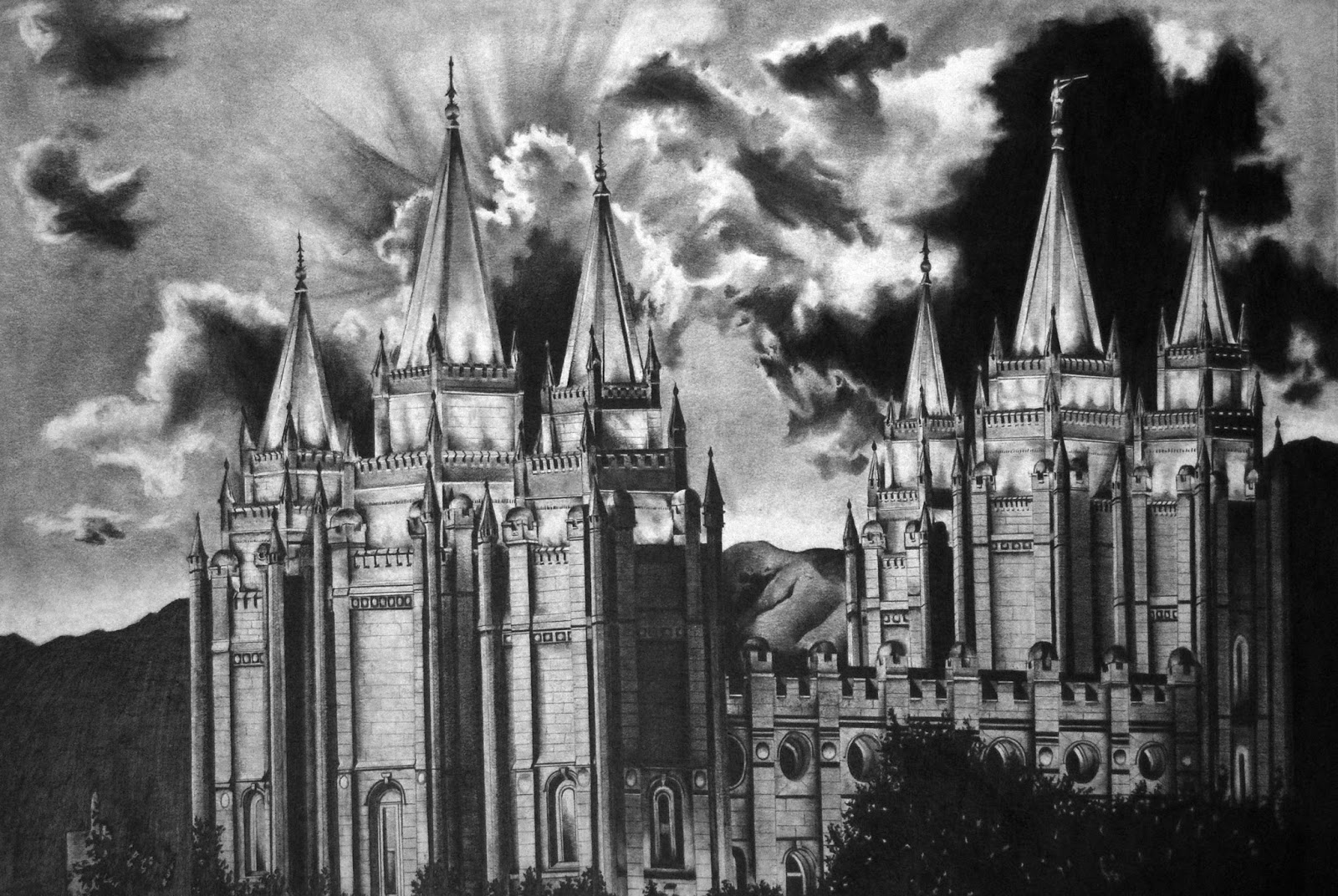
Pencil drawing by Steve Arave
Levan, Utah: Sinkng the 'Navel myth'
By Lynn Arave
Is the Beehive State’s most common
“belly button” joke true? Is Levan, Utah, in Juab County, actually named
for being the word “navel” spelled backwards, since geographically a belly
button would be about where this town is located, in the center of Utah?
As amusing and widespread as this strange name origin is, it is
likely not true. However, myth can supersede fact over time and that is almost
surely what has happened with Levan’s origin.
Consider the following:
-The likely first-ever public reference to the town of Levan was
in the Deseret News on May 6, 1868:
“A new town site has been surveyed
between chicken and pigeon
creeks on the east side of the valley some three and half miles northeast of
the old Chicken Creek settlement. A field has also been surveyed and
improvements have commenced. The new location is called Levan.”
Now one problem here is that you’ve got to
adjust for history and different borders back then. In 1868, there was NO State
of Utah -- that was 28 years distant.
It was the Territory of Utah, with the
borders including a portion of western Colorado and a chunk of Wyoming. Thus,
the Territory was wider in 1868 than today and not as conducive to adding a
"navel" to it, at least where Levan is located.
Wyoming was made a state three months
after the community of Levan began (taking away that "chunk" from
Utah) and the State of Colorado came along in 1876. So, Utah's borders weren't
like today until 1876, eight years after Levan came along.
(Nevada was made a State in 1864, but Utah
territory kept a portion of today's Nevada until boundary changes in January of
1867.)
Even if Brigham Young named the community, it likely wasn’t for the navel reason.
And, furthermore, why in the world would
Brigham start out a new town with a joke kind of name, given the rough living
conditions of the territory back then?
The masterful book, “Utah Place Names,”
John W. Van Cott states on the Levan monkier: “There are several French, Latin,
or Piute interpretations of the name, suggesting it means East of the Sunrise,
Land of the Sunrise, Rear rank of a moving Army, Frontier Settlement or Little
Water. The tongue-in-cheekers say the name is a reverse spelling of Navel,
because it is located in the center of the state. Several different spellings
have been recorded.”
Any of those meanings probably make more
sense than navel.
Yet, ultimately Navel is still becoming
the origin of the name Levan, because of extreme popular reference over time.
Former Levan Mayor Connie Dubinsky was
quoted in the Salt Lake Tribune on March 4, 1997 as saying,
''We don't really know for sure, but that's what we tell people.'’
So, this is really more a case of almost universal acceptance of a
myth that becomes truth over time. Thus, technically Levan is not a 'belly
button" town, but it is the "Navel" community by default.
AND, ever since one of the last new sections of I-15 opened in
1986 and meant most Utahns bypass Levan, the little town needs ALL the
publicity it can get.
Levan is located about 11 miles south of Nephi along U-28. Before
1986, the majority of drivers went directly through Levan.
Also note too that U.S. Highway 89,
between Logan and Brigham City, is not almost universally called "Sardine
Canyon," even though the actual Sardine Canyon isn't traversed there. Again,
popular usage became the rule.)
Secondly, note also that some local
histories of Levan don’t even have the Chicken Creek reference correct, since
they state that Chicken Creek was Levan’s original name. No, Chicken Creek was
a former settlement, located 3.5 miles northeast of Levan.
-Another strange moniker was the town of Payson’s original title.
It was originally named “Peteetneet.”
It was titled for the
creek in the area and after a local Indian chief. Later, the branch of the LDS
Church was named Peteetneet too. Then, the town was renamed after James Pace, a
settler who led the emigrants there. At first it was spelled “Pacen” and later
“Payson.”
-Here are some other odd Utah names, past and
present:
Delicate Arch in Arches National Park was originally
known by three other names: Schoolmarm's Bloomers, Cowboy Chaps and Mary's
Bloomers.
Fairfield,
west of Utah Lake in Utah County, was first known as Frogtown, for the
plentiful amphibians in the nearby Sevier River.
"Ragtown"
was the original name for Magna, which also, for some reason, surrendered its
attractive second title, "Pleasant Green" too.
Baptist Draw, in Emery
County, received its name when early settler Joe Swasey "baptized"
his dog by tossing it into one of the draw's water pockets.
Bottle Hollow, Uintah
County, was so named because it was a mile-long dump for empty liquor bottles
of U.S. soldiers stationed at Fort Duchesne in the 1880s.
China Lake in Summit
County got its name either after a Chinese man and his mule drowned in it or
because it was said you could sink down to China before reaching the bottom of
the deep lake.
Deadman Ridge, Garfield
County, got the title after Myron Shurts was killed by lightning there in 1912.
SOURCES: Deseret News
Archives, “Utah Place Names,” by John W. Van Cott.
\
Subscribe to:
Posts (Atom)