Monday, December 19, 2016

From "Little Zion" to "Joseph's Glory" to "Mukuntuweap" and more -- Zion National Park


By Lynn Arave

ZION NATIONAL PARK -- THE name of the majestic gorge with sheer sandstone walls half-a-mile high seems to fit so well that its origin is rarely questioned anymore. But in fact, Zion has been known by at least half-a-dozen other titles.

A reference in National Geographic magazine reminds us the Zion name was not an instant fixture. A map supplement in the October 1992 issue mentions that Brigham Young emphasized to early settlers in the Springdale area that the canyon was not Zion, despite their heavenly descriptions. So, some of the settlers started sarcastically calling the area "Not Zion" in the 1860s. The first white man to see Zion is believed to have been Nephi Johnson, who in November 1858 rode halfway up what is now known as the paved "Gateway to the Narrows" trail to "Zion Stadium," a natural amphitheater. By another account, he only went as far as the Great White Throne.


Johnson was a Mormon scout, looking for good places for the Saints to settle. He had an Indian guide with him who refused to go any farther than the present site of Springdale. The Indian said the devil lived farther up, in the area where the sun never shined, and he feared injury and death from evil gods who dwelt there.

Other information indicates there may have been occasional fatal falls by Indians who climbed up rock footholds to the tops of the plateaus and peaks, so they likely regarded Zion as a dangerous area.

Indians apparently knew the canyon by various names. "Ioogoon" is one, translating to "Arrow quiver" or "Come out the way you came in."

Explorer John Wesley Powell visited Zion in 1872 and applied some Indian names to the gorges there, such as "Mukuntuweap" (meaning "Straight Canyon") to the North Fork of the Virgin River and "Parunuweap" ("Water that Roars") to the East Fork. He was one of the first to call broader attention to the area's scenic wonders - something settlers struggling to survive had no time to appreciate or promote.

NEPHI JOHNSON, for one, was apparently not overly impressed by Zion - at least from a settler's point of view - and didn't even report his discoveries to others. It just didn't seem promising for farming. Johnson also found little evidence of previous Indian settlements there.

Several years later, Joseph S. Black, another Mormon pioneer, followed the Virgin River into Zion and was so impressed by the natural beauty that he provided was seemed to be unbelievable descriptions of the area to other settlers. Some of the more skeptical of them dubbed the place "Joseph's Glory" in reference to what they thought were his exaggerated claims.

Isaac Behunin was actually the first to settle there. In January 1862 he built a cabin in Springdale. In the summer of 1863 he raised a one-room cabin not far from where Zion Lodge is now. Behunin also built a canal, planted fruit trees and grew cane and garden vegetables in Zion. Behunin Canyon northwest of the Emerald Pools is named in his honor.

Other settlers followed. William Heaps built a log cabin at the mouth of Emerald Pools Canyon, and John Rolf established several cabins in Zion, including one near what is now the Grotto picnic area.


Behunin may have been the first to use the name by which it is today world renowned. He called the canyon "Little Zion." Other reports indicate the area was also referred to as "the Heavenly City of God" in the 1860s.

"Little Zion Valley" was another name used to describe the area, as evidenced by many references in Utah newspapers, like the Washington County News of July 1, 1909. By 1917, it was "Little Zion Park" as an often-used title.

According to research by the Washington County Chapter of the Daughters of Utah Pioneers, it is not exactly known what the name Zion referred to. It might have been related to the peaceful security settlers felt in Zion Canyon because the Indians stayed away from there or because the towering walls offered natural protection.

Another possible derivation may be from the United Order, a Mormon pioneer system of sharing all things in common, that was prevalent in southern Utah at the time. This could have made for a utopia - a Zion - at least for a short time.

By 1875, however, no one was living in Zion Canyon, possibly in part because the United Order con-cept had been discontinued and many residents had moved away. In 1863, as many as 20 families may have been living on the North Fork of the Virgin River, yet by 1864 only nine were left. Frequent and unpredictable flooding was another problem for settlers in the Zion area.

G.K. GILBERT, who visited Zion in 1872, is credited with naming "the Narrows" and for being the first explorer to fully appreciate their wonder.

The area was mapped extensively in the 1880s by the U.S. government, but Zion was basically cut off from the thoroughfares of the rest of the world until well into the 20th century, with no railroad nearby and poor roads.

Arable land in the canyon continued to be farmed by residents of Springdale and Rockville until the area earned national park status. Sheep also grazed in the area until 1909. Perhaps unjustly, farmers and ranchers received no financial compensation for the loss of their land when the canyon was included in a national monument.

In 1909 part of Zion was set aside as Mukuntuweap National Monument by President William Taft. By 1918, President Woodrow Wilson had enlarged the area and changed the name back to Zion because the Mukuntuweap name was an unpopular title locally. (Parunuweap was retained as the name of a small canyon southeast of Zion.)


                              A lower section of Angels Landing.

The Rev. Frederick Vining Fisher, an Ogden Methodist minister visiting the canyon with friends in 1916, is credited with giving several Zion landmarks the "heavenly" names that persist to this day. Among them: the Great White Throne, the Three Patriarchs (Abraham, Isaac and Jacob) and Angels Landing.

Today's park is rife with connotations and descriptions of that variety that seem so appropriate to Zion: the North and South Guardian Angels, Tabernacle Dome, Mount Moroni, the East and West Temples, the Altar of Sacrifice, Kolob Arch, Cathedral Mountain, the Temple of Sinawava.

In 1929, Congress gave Zion national park status, and the boundaries were extended to their cur-rent range.

By 1923 the railroad had reached Cedar City, and a graded wagon path was prepared as far as Weeping Rock. The Zion tunnel was started on the fall of 1927 and, when completed in 1930, this engineering marvel of its time soon improved accessibility to the park.

Today, the name Zion usually summons images of a popular scenic attraction that's also a place of refuge for the wildlife protected within its borders. Still, a visit to Zion - even in the 1990s - reveals there are several religious groups that frequent Zion and who regard it as exactly that - a sacred area. One group even believes it to be the ancient home of Abraham and Israel.

But even for those not inclined to zealotry, no other name seems to better fit this spectacular area than the name most everyone knows it by - Zion.

(-Revised from a Deseret News article by Lynn Arave and Ray Boren on April 29, 1993.)

Thursday, December 15, 2016

When a new name was sought for Bryce Canyon in the 1920s, like 'Utah National Park'


         Bryce Canyon National Park could have been renamed "Utah National Park."

By Lynn Arave
BRYCE Canyon WASN'T always accepted as the name to a scenic wonderland of Southern Utah. In 1920 -- even before Bryce was a national monument -- there was a strong movement to rename the area something different to better conform to geology and geography.
"New name wanted for Bryce Canyon" was a June 8, 1920 headline in the Salt Lake Herald newspaper.
A state-wide contest was held by the Utah State Automobile Association to find a more suitable title for Bryce, because it wasn't really a "canyon," but an "amphitheater."
At that time, the early 20th Century, Bryce was also sometimes referred to as "Temple of the Gods," since that it is what the place was referred to on official federal maps.
Others referred to it as "Bryce's Canyon."
Since Colorado boasted a place named "Garden of the Gods," the "Temple of the Gods name was not considered confusing and not suitable.


The winner to the contest to rename Bryce, with the chosen name, would earn an all-expense paid trip to Bryce and Zion National Park.
"Bryce Canyon to be renamed" was a June 8, 1920 headline in the Ogden Standard-Examiner newspaper, as all major Utah papers carried the news of a big contest.
Apparently, many early visitors to Bryce had been complaining that Bryce CANYON was not an accurate title for the scenic marvel and that a new title was needed before Bryce gained world-wide fame in coming years.
Bryce Canyon was named for Ebenezer Bryce, a Mormon Pioneer who homesteaded in the area in 1874. He also reportedly proclaimed it was a helluva place to lose a cow.
Bryce became a national monument in 1923 and a national park in 1928.
The renaming contest, however, did not go smoothly.
"Garfield Count protests renaming of Bryce Canyon" was a June 12, 1920 headline in the Salt Lake Herald.
That story reported that the Utah State Automobile Association agreed that Garfield County, home to Bryce Canyon, should have a strong say in the renaming process, but that the new name contest would continue.
"We are not trying to dictate the name of anything and we would not attempt to foist an undesirable name upon any section of the state," W. D. Rishel, manager of the Utah State Automobile Association, stated in the Herald story.
He continued, "Our efforts in securing a more suitable title were solicited by hundreds of visitors, who declared that Utah is hiding the most singular scenic attraction in the world under the most commonplace title."
When the renaming contest had run its course a few weeks later, it was concluded that the judges could not find a more suitable title, despite hundreds of suggested names by the public.
"Bryce name to stand" was a July 8, 1920 headline in the Salt Lake Herald.
"No better title that the present name of Bryce Canyon was found by the board of judges ..." the story concluded.

-Jump forward eight years, to 1927, and the leading new name for Bryce Canyon National Park was Utah National Park.
The Ogden Standard-Examiner of July 21, 1927 states that Utah Governor George H. Dern said that the Utah National Park name was "highly objectionable," because "much money had been expended in bringing the name of Bryce to the attention of travelers." 


(-Originally published in the Deseret News on May 13, 2019.)


Thursday, December 8, 2016

'Epidemic of Runaway Couples' in 1907 Ogden


By Lynn Arave

"Epidemic of Runaway Couples: Six young people from Salt Lake married; They like Ogden's way of doing things -- Surprise for the folks at home" was a June 24, 1907 headline in the Ogden Standard-Examiner.
The article mentioned how Ogden's pastors must be more accommodating than Salt Lake City's and hence why so many young couples were eloping some 36 miles north to Ogden fo
r a quick and less-questions-asked marriage.
The story stated that "the number of runway couples that come from Zion to be married in Ogden is steadily on the increase."
The also stated that two "supposedly confirmed bachelors, widely known to the businessmen of Salt Lake" traveled to the Hermitage in Ogden Canyon for their honeymoon, as they ended "their state of single blessedness."
"Salt Lake Girls run away to get married in Ogden" was a June 21, 1922 headline in the Standard-Examiner, and so this trend of runaway couples coming to Ogden for a quick marriage continued, at least for more than a decade.


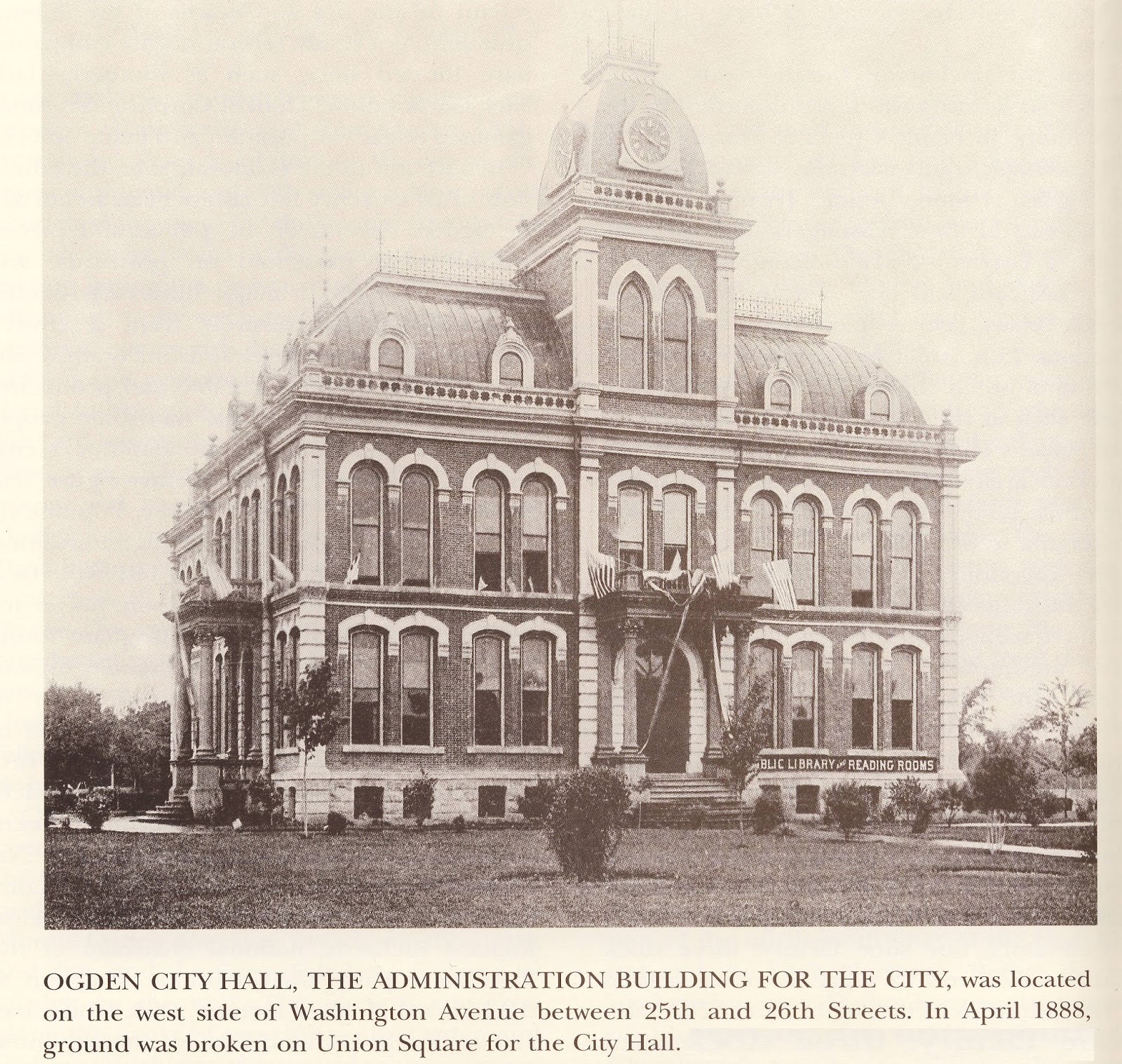
                                 The old Ogden City Hall.

'A Novel Ride' in 1891 down Waterfall Canyon?

              The view down Waterfall Canyon, west, from just below the Waterfall.


By Lynn Arave

 SOMETIMES historical accounts just aren't detailed enough.
EXAMPLE: A May 21, 1891 article in the Ogden Standard-Examiner, reported that a group of Ogden residents hiked up to Observatory Peak (Mount Ogden) by way of Waterfall Canyon and then road back down "on snow toboggans, having a fine ride of over a  mile and a half down on the snow," it was stated. The headline of the story labeled it "A Novel Ride."


                          The view eastward at the mouth of Waterfall Canyon.

   Where exactly did the group slide down on the snow?
Given the terrain of this area, the area around the waterfall of Waterfall Canyon is a steep cliff. It certainly wasn't there.
In the deep winter, it is possible to walk right over top of the Waterfall stream, most of the way up the canyon. However, in late May, that seems unlikely.

So, the only place this group could have actually slid on toboggans was much higher up the mountain -- between Malan's Basin and Mount Ogden. Here, in late May, the snow could have still been deep. However, who would haul a toboggan (likely a long, narrow board of wood in that era) that far up the mountain? That would have been a grueling ordeal, of 5 or more miles and almost a mile of vertical climb.
But, hey there weren't ski resorts back then and so maybe that's the effort it took for a good snow thrill well over a century ago ......?


                       The view from Malan's Basin to Mount Ogden.

First Exploration of Logan Cave: 1892?

                    Logan Cave entrance, before it was gated shut, circa 1988, with Scott Thompson.


By Lynn Arave

LOGAN Cave was a tourist attraction in Logan Canyon, Utah, along Highway 89, for almost a century. The Cave was gated shut in the late 20th Century, to protect its native inhabitants, bats.
(Today, mention "Cave" and Logan Canyon and it is the Wind Caves that are more well-known and visited.)
Although Logan Cave can be spotted easily --  if you know where to look -- along today's paved Highway 89, it apparently wasn't always so.
The Brigham City Bugler newspaper of July 23, 1892, records what may be the first-ever public references to Logan Cave.
The article reports that attorney B.H. Jones had a "delightful trip through the large cave" in the summer of 1892.
"It contains a large stream of water and a lake," The Bugler article stated. "The walls of the cave are said to be so high that a man can walk upright a whole mile and not reach the end. Lanterns are used in reaching the depths of that dark cavern, as no crevices are found in the massive walls to admit light. The air is cool and refreshing at midday, when all is hot and sultry without," the 1892 article concluded.
-Today, Logan Cave is believed to be 4,290-feet long. Public access seems to be rarely permitted.
Logan Cave is located 11.9 miles up Logan Canyon on the north side of the highway, about 50 feet above the paved highway.
The cave itself varies from 5-10 feet wide with a ceiling height between 30 and 100 feet. It has three levels and in normal water years has a stream flowing out of it that can be knee-deep in spots. The cave is dry during some summers.
The cave was formed by the seepage of water through limestone and has a year-round temperature of about 50 degrees.
Most geological features in the cave have been destroyed by vandals, and litter and graffiti were cave problems over the years too.

When Utah's Steepest State Road, Highway 143, was forged: 1933-1934

                          Today's Highway 143.                                              Photo by Ravell Call.

By Lynn Arave
THE steepest state highway in Utah, U-43, from Parowan to Cedar Breaks, was forged during heavy construction efforts, mainly in 1933-1934.
According to the Garfield County News of Aug. 10, 1934, the road was fully open by that time, as part of a CCC (Civilian Conservation Corps) Camp effort.
This road has a 13 percent maximum grade and tops out at 10, 567 feet above sea level. (Most Interstate Highways only have a 6 percent maximum grade.) The winding road will provide a rugged workout for any vehicle's brakes/engines.
The Garfield County News had reported  on Aug. 25, 1933, that the road was originally known as "The Bowerly Road" and that its importance was connecting with the Duck Creek-Cedar Mountain Road (today's Highway 14).


               The rugged terrain around the Brian Head area and Highway 143.
                                                                              Photo by Ravell Call.

The newspaper also outlined some of the challenges with creating the steep, 18-mile-long path: at one point it was required to make a n 80-foot deep by 1,000-foot long cut through solid rock.
The final pioneer way on the adjacent Highway 14, from Cedar City, past Navajo Lake, and to Long Valley Junction, was done in the early 1930s, with most of the effort done by the fall of 1932, according to the Garfield County News of Sept. 2, 1932.
This road construction also provided much needed paid employment to area men, jobless during the Great Depression of that era.
In fact, the U.S. Forest Service hired men for just two weeks at a time for the project during 1932, so that additional men could also gain temporary employment for two weeks at a time, as well.    

Note: This area was devastated by a massive forest fire in 2017.

                              Highway 143                                            Photo by Ravell Call.

The beginnings of the Aspen Grove Highway: 1916-1917

By Lynn Arave

WHEN did the Aspen Scenic Highway through American Fork Canyon in Utah originate?
It was the summer of 1917 when much of the road was cut through the forest, that goes past Timpanogos Cave and Aspen Grove, on an intersect course with Provo Canyon.
According to the Ogden Standard-Examiner of Dec, 6, 1916, plans were made the winter prior for this "motor car route." The initial cost was $30,000 (or just over $660,000 in 2016 dollar value).
Surprisingly, the initial plan was to take a car road all the way to the glacier base of Mount Timpanogos. That obviously didn't happen, because of the rugged terrain. Still, today's road tops out at 8,078 feet above sea level, in heavily forested terrain.
Even today, the Alpine road on the eastern side of the Wasatch Mountains is mighty narrow, but 1916-1917 work marked the initial beginnings of the 24-mile scenic loop highway (State road No. 92).
Timpanogos Cave National Monument wasn't established until 1922, so this pioneer road work predates that.
Much of the interest in hiking to Timpanogos Peak came in the early 1920s, or just after road access to Aspen Grove was created.


                Mountain goats roaming around Timpanogos Peak.
                                                                                                                       Photo by Ray Boren.